
Laboratory Upkeep
Laboratory upkeep is an important facet of any lab safety program. It includes proper space allocation and management, the maintenance of an accurate chemical inventory, the maintenance of equipment such as vacuum pumps and hot plates, effective measures to ensure the security of the space, and well-planned strategies for transporting chemicals to and from the lab. A lab space that is well-maintained protects people in it from encountering hazards unexpectedly, provides for the security of the lab’s personnel, equipment, and chemicals, and improves the efficiency and safety of lab operations. EH&S requires that academic research laboratories at UCLA utilize the Laboratory Hazard Assessment Tool (LHAT) to self-identify hazards present in the lab’s space or work practices. Completing the LHAT is a preliminary step in communicating hazards to lab personnel and directing lab upkeep efforts.
Space Management
Managing the space in a laboratory involves choosing proper locations for equipment, storage cabinets for research materials, and designating work areas for the handling of especially hazardous substances. It also involves basic housekeeping tasks like keeping worksurfaces uncluttered and decontaminated, and ensuring that all aisles or other paths of travel have adequate clearance (minimum 24” width).
Space limitations and chemical incompatibilities necessitate that careful thought goes into what is purchased, where it is kept, and how it is discarded when no longer in use. Flammable storage cabinets, corrosive storage cabinets, glove boxes, and refrigerators/freezers are all considered primary storage locations within a lab and should be utilized to store flammable, corrosive, air/water reactive, and temperature-sensitive chemicals, respectively. When chemical incompatibilities are present within these primary storage locations, segregation and secondary containment are the two tools most often used to manage the space. Finally, designated areas should be used for the handling and/or storage of toxic, carcinogenic, and other high hazard substances, including hazardous chemical waste, to simplify decontamination procedures and prevent accidental exposure via access control.
Chemical Storage
Establish and follow safe chemical storage & segregation procedures for your laboratory. Storage guidelines are discussed below for materials that are flammable, combustible, oxidizing, corrosive, water reactive, pyrophoric, and peroxide-forming. The specific Safety Data Sheet (SDS) should always be consulted when doubts arise concerning chemical properties and associated hazards. All procedures employed must comply with Cal/OSHA, Fire Code, and building code regulations. Each laboratory is required to conduct lab-specific training on the hazardous chemicals and to effectively communicate the hazards stored in a laboratory. Table 4.1 lists chemical safety storage priorities.
Chemical Expiration
All hazardous chemicals must be disposed of by the manufacturer’s expiration date. In cases where no expiration date is listed on the product, the chemical must be disposed of within 3 years of opening or within five years of receipt if unopened. Expiration guidelines for time-sensitive chemicals are provided in Chapter 3. Chemicals with functional groups that react with oxygen or water should be disposed within no more than one year of opening. This includes aldehydes, amines, aryl halides, cyanides, diazenyls, hydrides, organometallics, peroxides, and silyl halides. Ensure all chemicals are labeled with the received date and opened date to ensure proper storage and disposal. If either date is missing, the date of manufacturer will be assumed to be the date of receipt and opening. More information on chemical storage and disposal can be found on the EH&S website.
General Recommendations for Safe Storage of Chemicals
Each chemical in the laboratory must be stored in a specific location and returned there after each use. Acceptable chemical storage locations may include corrosive cabinets, flammable cabinets, laboratory shelves, or appropriate refrigerators or freezers. Fume hoods should not be used as general storage areas for chemicals, as this may seriously impair the ventilating capacity of the hood. Chemicals should not be routinely stored on bench tops or stored on the floor.
Chemical Safety Storage Priorities
Keep in mind that most chemicals pose multiple hazards and a decision must be made as to which storage area would be most appropriate for each specific chemical. First you have to determine your priorities:
- Flammability. When establishing a storage scheme, the number one consideration should be the flammability characteristics of the material. If the material is flammable, a flammable cabinet or a refrigerator rated for flammable storage is the best practice. The maximum amount of flammables allowed outside a flammable storage cabinet, safety can, or approved refrigerator/freezer is 10 gallons. Individual containers greater than 1 gallon (4L) that are not safety cans, must be stored in an approved flammable storage cabinet/refrigerator/freezer.
- Isolate. If the material will contribute significantly to a fire (e.g., oxidizers), it should be isolated from the flammables. If there were a fire in the laboratory and response to the fire with water would exacerbate the situation, isolate the water reactive material from possible contact with water.
- Corrosiveness. Next, look at the corrosiveness of the material, and store accordingly.
- Toxicity. Finally, consider the toxicity of the material, with particular attention paid to regulated materials. In some cases, this may mean that certain chemicals will be isolated within a storage area. For example, a material that is particularly hazardous substances but is also flammable, should be stored in the flammable storage cabinet to protect it against accidental release.
There will always be some chemicals that will not fit neatly in one category or another, but with careful consideration of the hazards involved, most of these cases can be handled in a reasonable fashion. Please contact laboratorysafety@ehs.ucla.edu with any questions.
Laboratory shelves should have a raised lip along the outer edge to prevent containers from falling. Hazardous liquids or corrosive chemicals should not be stored on shelves above eye-level and chemicals that are particularly hazardous substances or corrosive should be in unbreakable secondary containment. Chemicals must be stored at an appropriate temperature and humidity level and should never be stored in direct sunlight or near heat sources, such as laboratory ovens. Incompatible materials should be stored in separate cabinets, whenever possible. If these chemicals must be stored in one cabinet, due to space limitations, adequate segregation and secondary containment must be ensured to eliminate the possibility of mixing and of adverse reactions. All stored containers and research samples must be appropriately labeled and tightly capped to prevent vapor interactions and to alleviate nuisance odors. Storing chemicals in flasks with cork, rubber or glass stoppers should be avoided because of the potential for leakage
Laboratory refrigerators and freezers must be labeled appropriately with “No Food/Drink” and must never be used for the storage of edible or drinkable items. Freezers should be defrosted periodically so that chemicals do not become trapped in ice formations.
Flammable and Combustible Liquids
Large quantities of flammable or combustible materials should not be stored in a working laboratory. The maximum total quantity of flammable and combustible liquids must not exceed 60 gallons within a flammable storage cabinet. The maximum quantity allowed to be kept outside a flammable storage cabinet, safety can, or approved refrigerator/freezer is 10 gallons with no container being larger than 1 gallon. Only the amounts needed for the current procedure should be kept on bench tops and the remainder should be kept in flammable storage cabinets, refrigerators/freezers that are approved for the storage of flammable substances, or approved safety cans or drums that are grounded.
Always segregate flammable or combustible liquids from oxidizing acids and oxidizers. Flammable liquids or gases must never be stored in domestic-type refrigerators/freezers, but in flammable-rated units instead. Flammable or combustible liquids must not be stored on the floor or in any exit access. Handle flammable and combustible substances only in areas free of ignition sources and use the chemical in a fume hood whenever practical. Only the amount of material required for the experiment or procedure should be stored in the work area. Always transfer flammable and combustible chemicals from glass containers to glassware or from glass container/glassware to plastic. Transferring these types of chemicals between plastic containers may lead to a fire hazard due to static electricity.
The UCLA Fire Safety in the Laboratory video provides additional fire safety information.
Pyrophoric & Water Reactive Substances
Because pyrophoric substances can spontaneously ignite on contact with air and/or water, they must be stored and handled under an inert atmosphere and in such a way that rigorously excludes air and moisture. Some pyrophoric materials are also toxic and many are dissolved or immersed in a flammable solvent. Other common hazards include corrosivity, teratogenicity, or peroxide formation.
Only minimal amounts of reactive chemicals should be used in experiments or stored in the laboratory. These chemicals must be stored as recommended in the SDS. Reactive materials containers must be clearly labeled with the correct chemical name, in English, along with a hazard warning.
Suitable storage locations may include inert gas-filled desiccators or glove boxes; however, some pyrophoric materials must be stored in a flammable substance-approved freezer. If pyrophoric or water-reactive reagents are received in a specially designed shipping, storage or dispensing container (such as the Aldrich Sure/Seal packaging system), ensure that the integrity of that container is maintained. Ensure that sufficient protective solvent, oil, kerosene, or inert gas remains in the container while pyrophoric materials are stored. Never store reactive chemicals with flammable materials or in a flammable liquids storage cabinet.
Storage of pyrophoric gases is described in the California Fire Code, Chapter 64. Gas cabinets with remote sensors and fire suppression equipment are required. Gas flow, purge, and exhaust systems should have redundant controls to prevent pyrophoric gas from igniting or exploding. Emergency back-up power should be provided for all electrical controls, alarms and safeguards associated with the pyrophoric gas storage and process systems.
Never return excess reactive chemical to the original container. Small amounts of impurities introduced into the container may cause a fire or explosion.
The UCLA Pyrophoric Liquid Safety video provides information about the safe handling of pyrophoric chemicals.
Oxidizers
Oxidizers (e.g. hydrogen peroxide, potassium dichromate, sodium nitrate) should be stored in a cool, dry place and kept away from flammable and combustible materials, such as wood, paper, Styrofoam, plastics, flammable organic chemicals, and away from reducing agents, such as zinc, alkaline metals, and formic acid.
Peroxide-Forming Chemicals (PFC)
Peroxide-forming chemicals (e.g. diethyl ether, cyclohexene, tetrahydrofuran) should be stored in airtight containers in a dark, cool, and dry place and must be segregated from other classes of chemicals that could create a serious hazard to life or property should an accident occur (e.g., acids, bases, oxidizers). All containers with PFCs should be labeled with the date received and the date opened. This information, along with the chemical identity, should face forward to minimize container handling during inspection. Minimize the quantity of peroxide-forming chemicals stored in the laboratory and dispose of peroxide-forming chemicals before peroxide formation. Carefully review all cautionary material supplied by the manufacturer prior to use. Avoid evaporation or distillation, as distillation defeats the stabilizer added to the solvents. Ensure that containers are tightly sealed to avoid evaporation and that they are free of exterior contamination or crystallization. Never return unused quantities back to the original container and clean all spills immediately.
If old containers of peroxide-forming chemicals are discovered in the laboratory, (the container is more than two years past its expiration date, the date of the container is unknown, or you are not comfortable handling the container), do not handle the container. If crystallization is present in or on the exterior of a container, do not handle the container. Secure it and contact the EH&S Hotline at 310-825-9797 for pick-up and disposal.
Disposal of expired peroxide-forming chemicals may incur a charge of $100 (at minimum) per container. When disposing of these chemicals, the laboratory must complete a recharge order request or P39 form.
Potentially Explosive Chemicals/Reactions
Potentially explosive chemicals (e.g. dibenzoyl peroxide, trinitrobenzene and derivatives, picric acid and picrate salts) should be stored at the manufacturers’ recommended temperature in a rated refrigerator, freezer, or cabinet. They should be kept away from heat, light, friction, impact, or any other potential initiating mechanisms. Store these chemicals away from flammable and combustible materials as well.
Additional considerations should be made for picric acid. It should be kept away from metals and metal salts, with which it can react to form highly explosive products. Picric acid itself becomes most explosive when dry, and therefore must contain at least 10% water for inhibition.
Manufacturers’ recommendations will not be available to guide the storage of potentially explosive chemicals generated in the lab (e.g. copper azide). Before synthesizing any chemical that may be potentially explosive, consult with EH&S and develop an SOP, including a storage plan.
Corrosives
Store corrosive chemicals (i.e., acids, bases) below eye level and in secondary containment that is large enough to contain at least 10% of the total volume of liquid stored or the volume of the largest container, whichever is greater. Acids must always be segregated from bases and from active metals (e.g., sodium, potassium, magnesium) at all times and must also be segregated from chemicals which could generate toxic gases upon contact (e.g., sodium cyanide, iron sulfide).
Specific types of acids require additional segregation. Oxidizing acids (e.g. nitric acid) must be kept away from flammables, combustibles, and reducing substances. This includes organic acids (e.g. acetic acid) and reducing acids (e.g. hydroiodic acid). Perchloric acid should be stored by itself, away from other chemicals.
Special Storage Requirements
Compressed Gas Cylinders
Compressed gas cylinders must be stored with the safety cap in place when not in use. Cylinders must be stored either chained to the wall or chained in a cylinder storage rack. The cylinders must be restrained by two chains; one chain must be placed at one third of the cylinder height from the top of the cylinder, and the other placed at one third of the cylinder height from the bottom of the cylinder (see Figure 4.2). For wall storage, no more than three cylinders may be chained together in the laboratory. Bolted “clam shells” may be used in instances where gas cylinders must be stored or used away from the wall. Store liquefied fuel-gas cylinders securely in the upright position. Cylinders containing certain gases are prohibited from being stored in a horizontal position, including those that contain a water volume of more than 5 liters. Do not expose cylinders to excessive dampness, corrosive chemicals or fumes.
Certain gas cylinders require additional precautions. Flammable gas cylinders must use only flame-resistant gas lines such as copper or stainless steel and must have all connections leak tested. Lines that carry toxic gases from cylinders and must have all connections leak-tested. Compressed oxygen gas cylinders must be stored at least 20 feet away from combustible materials and flammable gases.
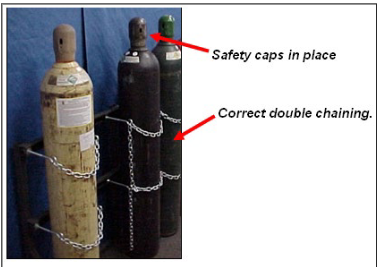
Gas cylinders must be inspected frequently for deterioration and must never be used without a regulator. Never use a leaking, corroded or damaged cylinder or regulator, and never refill compressed gas cylinders. When stopping a leak between cylinder and regulator, always close the valve before tightening the union nut. The regulator should be replaced with a safety cap when the cylinder is not in use. Move gas cylinders with the safety cap in place using carts designed for this purpose. Refer to the UCLA Compressed Gas Cylinder Storage and Handling policy for further details.
Liquid Nitrogen
Because liquid nitrogen containers are at low pressure and have protective rings mounted around the regulator, they are not required to be affixed to a permanent fixture such as a wall. However, additional protection considerations should be addressed when storing liquid nitrogen in a laboratory. The primary risk to laboratory personnel from liquid nitrogen is skin or eye thermal damage caused by contact with the material. In addition, nitrogen expands 696:1 when changing from a cryogenic liquid to a room temperature gas. The gases usually are not toxic, but if too much oxygen is displaced, asphyxiation is a possibility. For this reason, liquid nitrogen cylinders should be stored in areas with adequate ventilation. A physical hazard also exists for cryovials stored in the liquid phase, which may explode when warmed. Always use appropriate thermally insulated gloves when handling liquid nitrogen. Face shields may be needed in cases where splashing can occur, or when cryovials are being removed and warmed.
Chemical Segregation
Table 4.2 contains information regarding the general hazard class segregation that should be followed. These chemicals require separation by at least appropriate secondary containment and in some cases should be in different cabinets or locations completely. Such circumstance includes flammable and oxidizing gases.
| Table 4.2 Hazard Class Segregation | |
|---|---|
| Hazard Class | Keep out of contact with: |
| Flammables | Oxidizers |
| Acids | Bases |
| Organic acids | Inorganic acids |
| Water reactive chemicals | Water and aqueous solutions |
Chemical hazardous waste containing these hazard classes should also be segregated. Please see Chapter 5 for additional information on hazardous waste storage and segregation.
Table 4.3 contains a list of incompatible chemicals. The chemicals, listed in the left column, should not be used with chemicals listed in the right column, except under specially controlled conditions. Chemicals in the left column should not be stored in the immediate area with chemicals in the right column. Incompatible chemicals should always be handled, stored, or packed so that they cannot accidentally come into contact with one another.
This list is representative of chemical incompatibilities and is not complete, nor are all incompatibilities shown. Please see manufacturer’s SDS for additional information.
| Table 4.3 Incompatible Chemicals | |
|---|---|
| Chemical/Chemical Class | Keep out of contact with: |
| Alkaline metals, such as powdered aluminum, magnesium, sodium, potassium, etc. | Carbon tetrachloride or other chlorinated hydrocarbons, carbon dioxide, and water |
| Acetic Acid | Chromic acid, nitric acid, hydroxyl compounds, ethylene glycol, perchloric acid, peroxides, and permanganates |
| Acetylene | Chlorine, bromine, copper, fluorine, silver and mercury |
| Ammonia | Mercury, chlorine, calcium hypochlorite, iodine, bromine, and hydrofluoric acid |
| Ammonium Nitrate | Acids, metal powders, flammable liquids, chlorates, nitrites, sulfur, finely divided organic, or combustible materials |
| Carbon, Activated | Calcium Hypochlorite |
| Copper | Acetylene and Hydrogen Peroxide |
| Chromic Acid | Acetic acid, naphthalene, camphor, glycerin, turpentine, alcohol, and flammable liquids |
| Chlorine | Ammonia, acetylene, butadiene, butane, methane, propane, hydrogen, sodium carbide, turpentine, benzene, and finely divided metals |
| Cyanides | Acids - organic or inorganic |
| Hydrogen Peroxide | Copper, chromium, iron, most metals, alcohols, acetone, organic materials, aniline, nitromethane, flammable liquids, and combustible materials |
| Hydrogen Sulfide | Fuming nitric acid and oxidizing gases |
| Hydrocarbons (butane, propane, benzene, gasoline, turpentine etc.) | Fluorine, chlorine, bromine, chromic acid, and sodium peroxide |
| Iodine | Acetylene, ammonia, and hydrogen |
| Nitric Acid | Acetic acid, aniline, chromic acid, hydrocyanic acid, hydrogen sulfide, flammable liquids, flammable gases, copper, brass, and any heavy metals |
| Perchloric Acid | Acetic anhydride, bismuth and its alloys, alcohol, paper, wood, ether, oils, and grease |
| Phosphorus | Oxidizing agents, oxygen, strong bases |
| Potassium Chlorate | Sulfuric and other acids |
| Potassium Permanganate | Glycerin, ethylene glycol, benzaldehyde, and sulfuric acid |
| Sodium | Carbon tetrachloride, carbon dioxide, and water |
| Sodium Nitrite | Ammonium nitrate and other ammonium salts |
| Sodium Peroxide | Ethyl or methyl alcohol, glacial acetic acid, acetic anhydride, benzaldehyde, carbon disulfide, glycerin, ethylene glycol, ethyl acetate, methyl acetate, and furfural |
| Sulfuric Acid | Potassium chlorate, potassium perchlorate, and potassium permanganate |
Special Segregation of Incompatible Chemicals
In addition to the segregation noted in Table 4.3, dangerously incompatible substances, even in small
quantities, should not be stored next to each other on shelves or in such a position that accidental rupture
of containers may allow mixing.
Table 4.4 contains examples of dangerously incompatible substances. Table 4.5 contains examples of
incompatible oxidizing agents and reducing agents.
| Table 4.4 Dangerously Incompatible Substances | |
|---|---|
| Chemical/Chemical Class | Keep out of contact with : |
| Chlorine | Acetylene |
| Chromic Acid | Ethyl Alcohol |
| Oxygen (compressed, liquefied) | Propane |
| Sodium | Chloroform and Aqueous solutions |
| Nitrocellulose (wet,dry) | Phosphorus |
| Potassium Permanganate | Sulfuric Acid |
| Perchloric Acid | Acetic Acid |
| Sodium Chlorate | Sulfur in bulk |
| Table 4.5 Incompatible Oxidizing Agents and Reducing Agents | |
|---|---|
| Oxidizing Agents | Reducing Agents |
| Chlorates | Ammonia |
| Hexavalent Chromium | Carbon |
| Halogens | Metals |
| Halogenating AZgents | Metal Hydrides |
| Hydrogen Peroxide | Organic COmpounds |
| Nitric Acid | Phosphorus |
| Nitrates | Silicon |
| Perchlorates | Sulfur |
| Peroxides | |
| Permanganates | |
| Persulfates | |
Chemical Inventories
Each laboratory group is required to maintain a current chemical inventory. The chemical inventory list should be reviewed prior to ordering new chemicals and only the minimum quantities of chemicals necessary for the research should be purchased. As new chemicals are added to the inventory, each laboratory group must confirm that they have access to the Safety Data Sheets (SDS) for those chemicals. Where practical, each chemical should be dated so that expired chemicals can be easily identified for disposal. Inventory the materials in your laboratory frequently (at least annually) to avoid overcrowding with materials that are no longer useful and note the items that should be replaced, have deteriorated, or show container deterioration. Unneeded items should be returned to the storeroom/stockroom and compromised items should be discarded as chemical waste. Indications for disposal include;
- Cloudiness in liquids
- Color change
- Evidence of liquids in solids, or solids in liquids
- "Puddling" of material around outside of containers
- Pressure build-up within containers
- Obvious deterioration of containers
To facilitate improved inventory management and reporting, UCLA has implemented the Risk & Safety Solutions Chemical inventory system called RSS Chemicals (formerly known as UC Chemicals). RSS Chemicals allows UCLA to more easily comply with both long-standing and new regulation requiring chemical inventory maintenance and reporting. Cal/OSHA Title 8 Section 5194 (e) (1) requires that employers develop and maintain a list of the hazardous chemicals known to be present in the workplace. This is a long-standing regulatory requirement and is an important component of our lab safety inspections.
Additionally, Assembly Bill 2286103 mandates the development of the California Environmental Reporting System (CERS) and requires all regulated businesses to electronically submit chemical inventories.
The ChemTag program is a service EH&S offers to perform an initial inventory of your chemicals and provide annual reconciliation reports. The ChemTag team can also help you find a missing chemical that has been tagged and is in the current inventory. All UCLA PIs can log in to RSS Chemicals using their UCLA Logon credentials at http://ehs.ucop.edu/chemicals. Once logged in, PIs can designate “Inventory Managers” to manage their lab’s inventory. Additional information is available on the Chemical Inventory Program webpage.
The California Fire Code sets forth Maximum Allowable Quantities (MAQs) of hazardous chemicals that can be stored in any given area. The exact quantity of a chemical which may be stored varies depending on the class of chemical, the construction of the building it’s in, the floor it’s stored on, and whether it’s stored in a rated cabinet. The University of California Office of the President has mandated that all UC locations assess their status with respect to MAQ compliance, and develop plans to address any identified issues106. EH&S will assist labs in maintaining their inventories in accordance with these limits, and may require review of planned laboratory moves to ensure that these limits are not exceeded. Details regarding MAQ compliance at UCLA are available at https://ehs.ucla.edu/maximum-allowable-quantities-maq.
Questions and comments regarding RSS Chemicals and the Chemical Inventory Program should be directed to chemicalinventory@ehs.ucla.edu.
Laboratory Security
It is critical that chemicals be secured to prevent theft from campus laboratories. Numerous federal agencies are involved in the maintenance of laboratory security, including the Drug Enforcement Agency and the Federal Bureau of Investigations.
Access to hazardous chemicals, including toxic and corrosive substances, should be restricted at all times. These materials must be stored in laboratories or storerooms that are kept locked when laboratory personnel are not present. Locked storage cabinets or other precautions are always recommended, and in some cases may be required in the case of unusually toxic or hazardous chemicals. Unusually toxic chemicals may include those that are associated with very low immediately dangerous to life or health (IDLH) conditions. For guidance on locked storage requirements, please contact Chemical Safety at chemsafety@ehs.ucla.edu. On termination or transfer of laboratory personnel, all related hazardous
materials should be properly disposed of, or transferred to the laboratory supervisor or a designee.
It is each laboratory’s responsibility to prevent and report any theft of chemicals from their laboratory. Laboratories are encouraged to conduct a Security Value Assessment (SVA). Aspects that should be covered in a SVA include;
- Existing threats, based on the history of the institution (e.g., theft of laboratory materials, sabotage,
data security breaches, protests); - The attractiveness of the institution as a target, and the potential impact of an incident;
- Chemicals, biological agents, radioactive materials, or other laboratory equipment or materials with
dual-use potential - Sensitive data or computerized systems;
- Animal care facilities;
- Infrastructure vulnerabilities (e.g., accessible power lines, poor lighting);
- Security systems in place (e.g., access control, cameras, intrusion detection);
- Access controls for laboratory personnel (e.g., background checks, authorization procedures,
badges, key controls, escorted access); - Institutional procedures and culture (e.g., tailgating, open laboratories, no questioning of visitors);
- Security plans in place; and
- Training and awareness of laboratory personnel
Labs can increase their security by simply keeping lab doors closed and locked when unoccupied,
maintaining a current and accurate chemical inventory, training personnel on security procedures, and
controlling access to keys. Labs should report any suspicious activity to UC Police (310-825-1491) and the
UCLA EH&S hotline (310-825-9797).
Chemical Transport
On-Campus Distribution of Hazardous Chemicals
Precautions must be taken when transporting hazardous substances between laboratories. Chemicals must be transported between stockrooms and laboratories in break-resistant, secondary containment such as commercially available bottle carriers made of rubber, metal, or plastic, that include carrying handle(s) and which are large enough to hold the contents of the chemical container in the event of breakage. Compressed gas cylinders must be transported between rooms using a gas cylinder cart with the valve protection cap in place (see Figure 4.3). Refer to “UCLA's Chemistry and Biochemistry Department for information on the "Procedures for Transporting Chemicals"
Off-Campus Distribution of Hazardous Chemicals
The transportation of hazardous chemicals and compressed gases over public roads, or by air, is strictly governed by international, federal, and state regulatory agencies, including the U.S. Department of Transportation (DOT) and the International Air Transport Association (IATA). Any person who prepares and/or ships these types of materials must ensure compliance with pertinent regulations regarding training, quantity, packaging, and labeling. Without proper training, it is illegal to ship hazardous materials. Those who violate the hazardous materials shipment regulations are subject to criminal investigation and penalties. UCLA campus personnel who sign hazardous materials manifests, shipping papers, or those who package hazardous material for shipment, must be trained and certified by EH&S.
Individuals who wish to ship or transport hazardous chemicals or compressed gases off-campus, even when using UCLA or personal vehicles, must contact EH&S at laboratorysafety@ehs.ucla.edu or the EH&S Hotline at 310-825-9797 for assistance