
Chemical Hazard Classes & Incompatibilities
The Globally Harmonized System of Classification and Labeling of Chemicals (GHS) recognizes thirty-one classes of chemical hazards. These classes fall within three categories – physical hazards, health hazards and environmental hazards. A single material may exhibit more than one hazard. The hazard class(es) of a particular material will determine how it should be stored and handled and what special equipment and procedures are needed to use it safely. Each chemical container, whether supplied by a vendor or produced in the laboratory, must include labels that clearly identify the hazards associated with that chemical. In addition to specific chemical labels, hazard information for specific chemicals can be found by referencing the Safety Data Sheet (SDS) for that chemical.
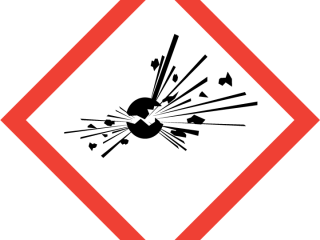
Explosive and Potentially-Explosive Chemicals
Explosive substances are materials that decompose under conditions of mechanical shock, elevated temperature, or chemical action, and release large volumes of gases and heat. These substances pose an immediate potential hazard and procedures which use or produce them must be carefully reviewed. These materials must be stored in a separate flame-resistant storage cabinet or, in many cases, in a laboratory grade refrigerator or freezer that is designed for storing flammable and reactive chemicals. Explosion hazards are indicated under GHS by the exploding bomb pictogram and a hazard statement including the word “explosive”.
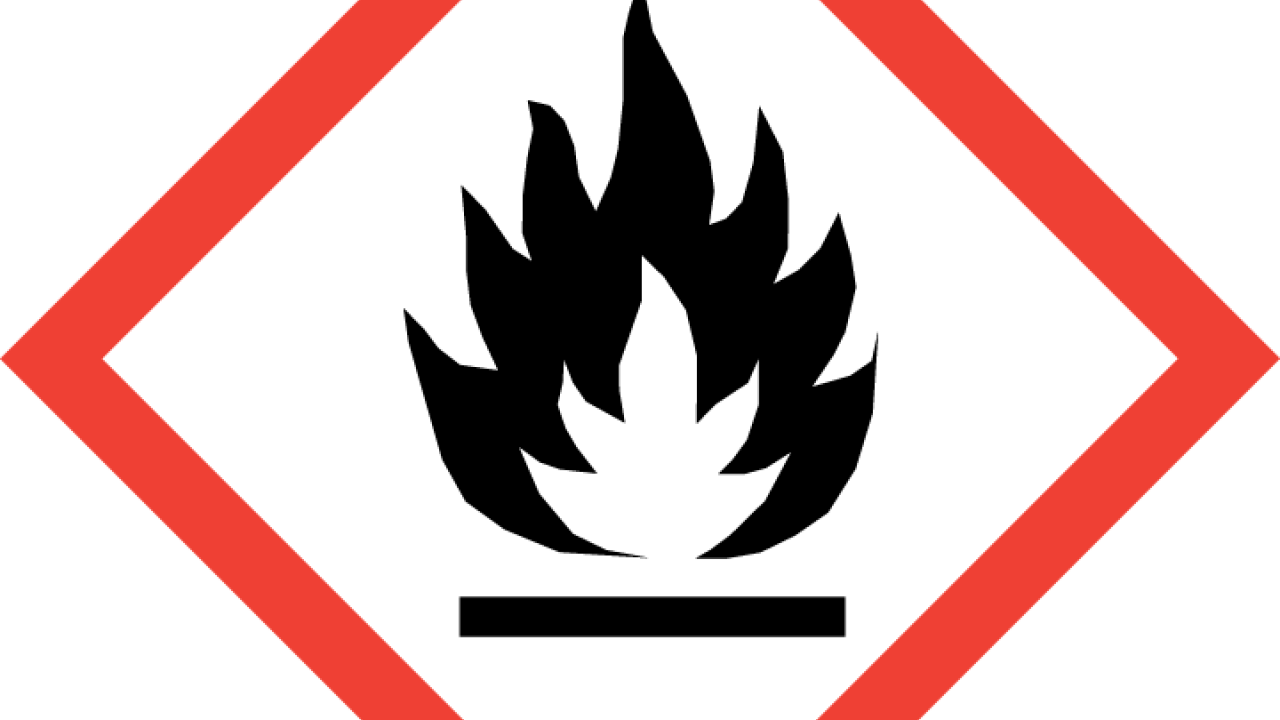
Flammable Chemicals
Flammable liquids include those chemicals that have a flashpoint of less than 100 °F. These materials must be stored in flammable storage cabinets if aggregate quantities of 10 gallons/room or more are stored in the lab and/or the size of any individual container is greater than 1 gallon (4 L). Flame-resistant laboratory coats must be worn when working with large quantities of flammable materials and/or with procedures where a significant fire risk is present (e.g., when working with open flame) as described in UCLA Policy 905 . These materials can constitute a significant immediate threat and should be treated with particular care, even though their use is common in the laboratory setting. Particular attention should be given to preventing static electricity and sparks when handling flammable liquids. This can be accomplished in part by grounding metal flammable storage cabinets and any metal dispensing drums inside them to either a cold water pipe or the building’s grounding system and bonding individual receiving containers to the dispensing drum.
Flammability hazards are indicated under GHS by the flame pictogram. Flammable solids, liquids, and gases are specified by a hazard statement including the word “flammable”. Pyrophoric materials are indicated by the hazard statement “Catches fire spontaneously if exposed to air.”
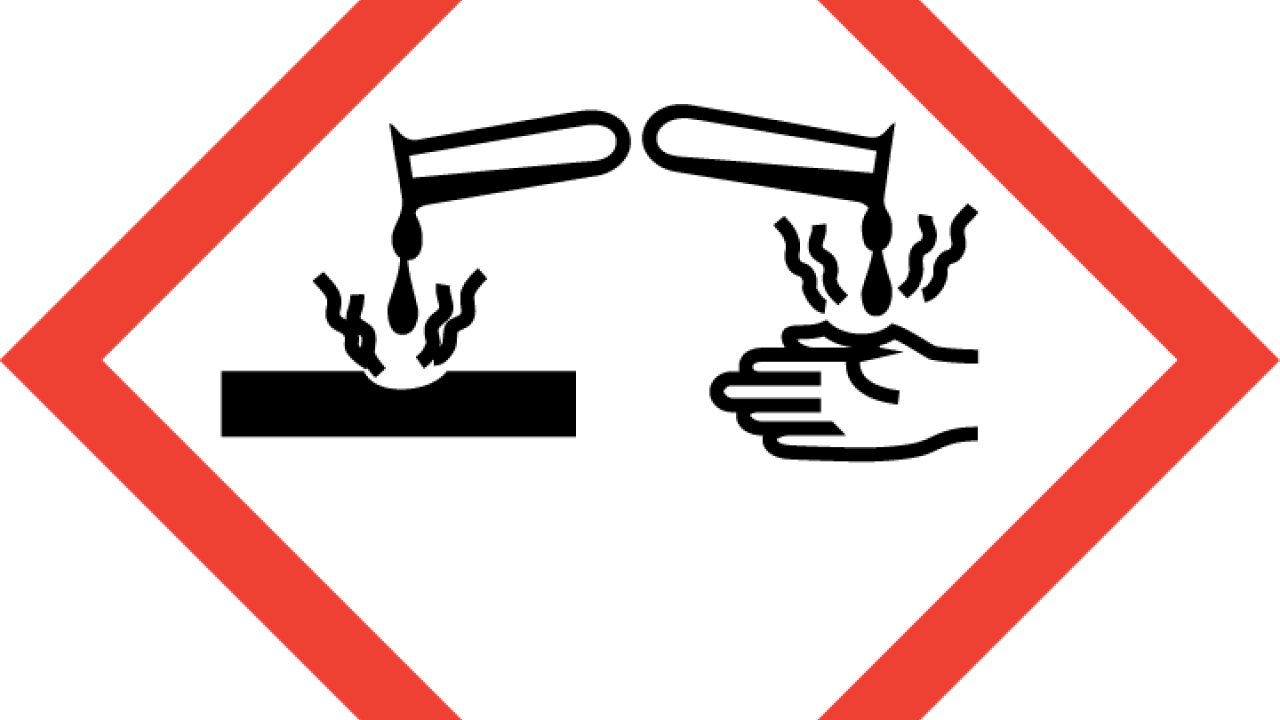
Corrosive and Irritant Chemicals
As a health hazard, corrosive substances cause destruction of, or alterations in, living tissue by chemical action at the site of contact. Major classes of corrosive substances include:
- Strong acids – e.g., sulfuric, nitric, hydrochloric and hydrofluoric acids
- Strong bases – e.g., sodium hydroxide, potassium hydroxide and ammonium hydroxide
- Dehydrating agents – e.g., phosphorus pentoxide and calcium oxide
- Oxidizing agents – e.g., hydrogen peroxide, chlorine and bromine.
Symptoms of exposure via inhalation include a burning sensation, coughing, wheezing, laryngitis, shortness of breath, nausea, and vomiting. For exposure to the eyes, symptoms include pain, bloodshot eyes, tearing, and blurring of vision. For exposure to the skin, symptoms may include reddening, pain, inflammation, bleeding, blistering and burns. Materials which are corrosive to tissue should always be stored below eye level to reduce the likelihood of splashes into the eyes. As a physical hazard, corrosive substances may degrade materials they come in contact with and may be violently reactive with other substances. It is important to review information regarding the materials they may corrode, and their reactivity with other substances, as well as information on health effects. In most cases, these materials should be stored in chemically-compatible secondary containment, and should be segregated from other classes of materials (e.g. store acids separately from bases or water-reactive materials).
Corrosive hazards are indicated under GHS by the corrosion pictogram and one or more of the hazard statements “May be corrosive to metals,” “Causes severe skin burns and eye damage,” or “Causes serious eye damage.”
Whereas corrosive chemicals irreversibly damage tissues, irritants are defined as chemicals that cause reversible inflammatory effects. A wide variety of organic and inorganic compounds, including many chemicals that are in a powder or crystalline form, are irritants. The most common example of an irritant may be ordinary smoke which can irritate the nasal passages and respiratory system. Consequently, eye and skin contact with all laboratory chemicals should always be avoided. Symptoms of exposure can include reddening or discomfort of the skin and irritation to respiratory systems. Irritants are indicated under GHS by the exclamation mark pictogram and a hazard statement which includes the word “irritation”.
Sensitizers
A sensitizer (allergen) is a substance that causes exposed individuals to develop an allergic reaction in normal tissue after repeated exposure to the substance. Examples of sensitizers include diazomethane, chromium, nickel, formaldehyde, isocyanates, arylhydrazines, benzylic and allylic halides, and many phenol derivatives. Sensitizer exposure can lead to all of the symptoms associated with allergic reactions, or can increase an individual’s existing allergies. Respiratory sensitizers are indicated under GHS by the health hazard pictogram and the hazard statement “May cause allergy or asthma symptoms or breathing difficulties if inhaled”. Skin sensitizers are indicated under GHS by the exclamation mark pictogram and the hazard statement “May cause an allergic skin reaction.”

Oxidizing Chemicals
Oxidizers (e.g., hydrogen peroxide, potassium dichromate, sodium nitrate) are substances that cause or contribute to combustion of organic materials. They often do so by giving up oxygen atoms. Oxidizers should be stored in a cool, dry place and kept away from flammable and combustible materials, such as wood, paper, Styrofoam, plastics, flammable organic chemicals, and away from reducing agents, such as zinc, alkaline metals, and formic acid. Oxidizers are indicated under GHS by the flame-over-circle pictogram and a hazard statement including the word “oxidizer”.

Water-reactive Chemicals
Water-reactive chemicals can evolve flammable or toxic gas when they come in contact with aqueous solutions or atmospheric moisture. This reaction may also produce enough heat to ignite any flammable gases thus generated. Water-reactives must be stored in tightly-sealed containers in a cool, dry place away from any potential water sources. They should also be stored away from acidic materials which could act as a source of protons and cause the evolution of the same gases.
Water-reactive materials are indicated under GHS by varying pictograms depending on the product of their reaction with water. Common examples include the flame pictogram, skull-and-crossbones pictogram, and corrosion pictograms. Water reactives are indicated under the National Fire Protection Association’s Standard System for the Identification of the Hazards of Materials for Emergency Response (NFPA 704) by a strikethrough “W."

Compressed Gases and Cryogens
Compressed gas cylinders can pose both physical and health hazards. Gas cylinders are pressurized vessels that pose a physical hazard if the pressure is released suddenly and violently. Compressed gases also pose the health hazard of asphyxiation if their rapid expansion displaces sufficient oxygen. Compressed gases are indicated under GHS by the gas cylinder pictogram and the hazard statement “Contains gas under pressure.”
Numerous gases are required for different reasons in the chemical research laboratory. Some gases have additional hazards such as flammability, toxicity, reactivity and/or pyrophoricity (e.g. hydrogen, ammonia, fluorine, and silane, respectively).
All compressed gas cylinders must be stored with the safety cap in place when not in use. Cylinders must be stored either chained to the wall or chained in a cylinder storage rack. Certain gas cylinders require additional precautions. Consult the section of this chapter on engineering controls for further details.
A special subset of compressed gases are cryogens (e.g. liquid nitrogen). The primary risk to laboratory personnel from cryogens is frost burn of the skin or eye caused by contact with the material. In addition, nitrogen expands 696 times its original volume when changing from a cryogenic liquid to a room temperature gas. This means that relatively small spills can displace sufficient oxygen to cause asphyxiation. Because liquid nitrogen containers are at low pressure and have protective rings mounted around the regulator, they are not required to be affixed to a permanent fixture such as a wall. However, additional protection considerations should be addressed when storing liquid nitrogen in a laboratory. Always use appropriate thermally insulated gloves when handling liquid nitrogen. Face shields may be needed in cases where splashing can occur, or when cryovials are being removed as they may explode when warmed. Cryogens are indicated under GHS by the hazard statement “Contains refrigerated gas; may cause cryogenic burns or injury.”
Pyrophoric Chemicals
Pyrophoric chemicals are a special classification of flammable materials that have autoignition temperatures below 130 °F, and thus may spontaneously combust in contact with air. Use of pyrophorics requires laboratory-specific training. They should be handled within a glove box whenever possible. Flame-resistant laboratory coats must always be worn when working with pyrophoric chemicals. Avoid using latex or nitrile gloves because they do not self-extinguish upon combustion. Chloroprene gloves, coupled with flame resistant glove liners, must be worn per UC policy when handling pyrophorics outside of a glove box. Pyrophorics must also always be stored and handled only in laboratories located within buildings that are fully equipped with emergency sprinkler systems.
Inquiries into laboratories that meet this requirement can be directed to EH&S by email at chemsafety@ehs.ucla.edu.
Particularly Hazardous Substances
Hazardous chemicals belonging to certain classes are considered "Particularly Hazardous Substances" (PHSs) by Cal/OSHA. Special provisions must be established to prevent the harmful exposure of researchers to PHSs, including the establishment of designated use areas, the use of containment devices, waste disposal, and decontamination procedures. Detailed information regarding designated areas, containment devices, and decontamination requirements can be found in the Control Measures section of this chapter. Detailed information regarding safe removal of hazardous waste containing PHSs can be found in Chapter 5. The use of PHSs on campus is governed by UCLA Policy 907 .
Particularly hazardous substances are divided into three primary types:
1. Carcinogens
2. Reproductive Toxicants
3. Acute Toxicants
Carcinogens
Carcinogens are chemical or physical agents that cause cancer. Generally, they are chronically toxic substances; that is, they cause damage after repeated or long-duration exposure, and their effects may only become evident after a long latency period. Chronic toxins are particularly insidious because they may have no immediately apparent harmful effects. Carcinogens are indicated under GHS by the health hazard pictogram and a hazard statement which includes the word “cancer”. These materials are separated into three classes;
A. Select Carcinogens
Materials which have met certain criteria established by the National Toxicology Program or the International Agency for Research on Cancer regarding the risk of cancer via certain exposure routes. It is important to recognize that some substances involved in research laboratories are new compounds and have not been subjected to testing for carcinogenicity. The following references (links provided) are used to determine which substances are select carcinogens by Cal/OSHA’s classification:
• OSHA Carcinogen List (29 CFR §1910.1003)
• Annual Report on Carcinogens published by the National Toxicology Program (NTP), including all of the substances listed as "known to be carcinogens" and substances listed as "reasonably anticipated to be carcinogens"
• International Agency for Research on Cancer (IARC), including all of Group 1 "carcinogen to humans", Group 2A “probably carcinogenic to humans” and 2B "possibly carcinogenic to human
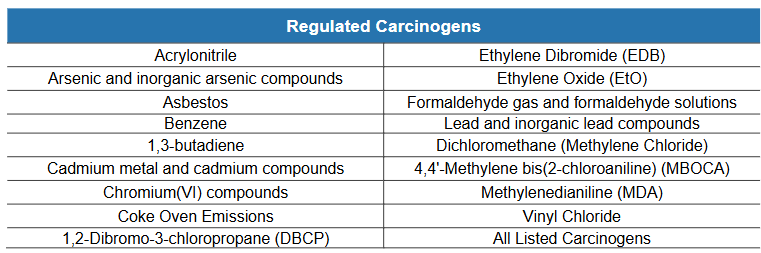
B. Regulated Carcinogens
These fall into a higher hazard class and have extensive additional requirements associated with them. The use of these agents may require personal exposure sampling based on usage. Any spill or release of, or suspected exposure to, a regulated carcinogen must be reported immediately to EH&S at 310-825-9797. When working with Regulated Carcinogens, it is particularly important to review and effectively apply engineering and administrative safety controls as the regulatory requirements for laboratories that may exceed long term (8 hour) or short term (15 minutes) threshold values for these chemicals are very extensive. The Regulated Carcinogens are :
C. Listed Carcinogens
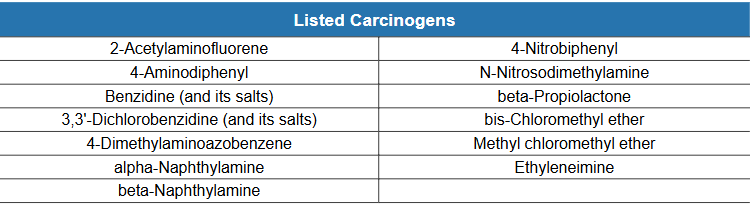
This is a term referring to a list of thirteen specific chemicals contained in 8 CCR §520967 that are considered to pose the highest cancer hazard. They have further requirements for their use in addition to those of regulated carcinogens. Given these strict regulations for Listed Carcinogen use, handling, and/or storage, the Chemical Hygiene Officer (CHO) must be contacted before any work with these agents begins. The Listed Carcinogens are:
Reproductive Toxicants
Reproductive toxicants include any chemical that may affect the reproductive capabilities, including chromosomal damage (mutations) and effects on fetuses (teratogenesis). Reproductive toxicants are indicated under GHS by the health hazard pictogram and hazard statements which reference damage to “fertility or the unborn child.” Reproductive toxicants which have effects on or via lactation are indicated by the hazard statement “May cause harm to breast-fed children.”
Reproductive toxicants can affect the reproductive health of both men and women if proper procedures and controls are not used. For women, exposure to reproductive toxicants during pregnancy can cause adverse effects on the fetus; these effects include embryolethality (death of the fertilized egg, embryo or fetus), malformations (teratogenic effects), and postnatal functional defects. For men, exposure can cause sterility.
Examples of embryotoxins include thalidomide and certain antibiotics such as tetracycline. Women of childbearing potential should note that embryotoxins have the greatest impact during the first trimester of pregnancy. Because a woman often does not know that she is pregnant during this period of high susceptibility, special caution is advised when working with all chemicals, especially those rapidly absorbed through the skin (e.g., formamide). Pregnant women and women intending to become pregnant should consult with their laboratory supervisor and their physician before working with substances that are suspected to be reproductive toxicants. UCLA Occupational Health also provides pregnancy consultations.
For further guidance on addressing male and female reproductive health risks, and how to reduce potential risks, please view Reproductive Risks in the Lab under How to Reduce Exposure to Hazardous Chemicals.
Chemicals Known to the State of California to Cause Cancer or Reproductive Toxicity
The Safe Drinking Water and Toxic Enforcement Act of 1986, also known as Proposition 65, requires the State to publish a list of chemicals known to cause cancer or reproductive toxicity. This list is updated regularly and reviewed by two committees that are a part of The Office of Environmental Health Hazard Assessment’s Science Advisory Board. The two committees are the Carcinogen Identification Committee
(CIC) and Developmental and Reproductive Toxicant Identification Committee (DARTIC).
Mutagens
Mutagens are materials that can cause a change (or mutation) in the genetic material of a living cell. Such mutations can lead to reproductive toxicity and play a significant role in the development of cancer. Mutagens are indicated under GHS by the health hazard pictogram and a hazard statement which references “genetic defects”.
Acute Toxicants
Acute toxicants are substances that may be fatal as the result of a single exposure or exposures of short duration via one or more of three routes, which is defined as any of the following:
• A chemical with a median lethal dose (LD50) of 50 mg or less (oral) per
kg of body weight;
• A chemical with a median lethal dose (LD50) of 200 mg or less (dermal)
per kg of body; or
• A chemical that has a median lethal concentration (LC50) in air of 500 ppm by volume or less of gas, 2.0 mg per liter or less of vapor, or 0.5
mg per liter or less of mist or dust, when administered by continuous inhalation for 4 hours (or less if death occurs within 4 hours).
Substances or mixtures classified by their manufacturer under GHS as Category 1 or Category 2 for acute
toxicity meet this definition, and are indicated by the skull-and-crossbones pictogram and a hazard
statement which specifies that they are “fatal” via one or more of the three covered exposure routes.
Toxic Substances
Substances which may cause toxicity as the result of a single exposure, but are typically not fatal in small doses, are considered toxic. Substances classified as Category 3 under GHS for acute toxicity are indicated by the skull-and-crossbones pictogram and a hazard statement which specifies that they are “toxic” via one or more of the three covered exposure routes. Substances classified as Category 4 or Category 5 for acute toxicity are indicated by the exclamation mark pictogram and a hazard statement specifying that they are “harmful” via one or more of the three covered exposure routes.
Substances which cause damage to target organs are also considered to be toxic, and are indicated under GHS by the health hazard pictogram and a hazard statement which specifies “damage to organs.” These include:
- Hepatotoxins – substances that damage the liver (e.g. nitrosamines, carbon tetrachloride)
- Nephrotoxins – substances that damage the kidneys (e.g. certain halogenated hydrocarbons)
- Neurotoxins – substances that damage the nervous system (e.g. mercury, acrylamide, carbon disulfide)
- Hematopoietic agents – substances that decrease hemoglobin function and deprive the body tissues of oxygen (e.g. carbon monoxide, cyanides)
- Respiratory Toxicants – Substances that damage lung tissue (e.g. asbestos, silica)
Symptoms of exposure to toxic and acutely toxic materials vary. Staff working with these materials should review the SDS for the specific material being used and should take special note of the associated symptoms of exposure.
Chemicals Hazardous to the Environment
Materials with demonstrated toxicity to aquatic organisms are classified as toxic to the environment. It is particularly important that such materials be stored in a manner which minimizes the risk of accidental release, and that they be disposed as hazardous waste. Materials which are toxic to aquatic organisms are indicated under GHS by the environment pictogram and a hazard statement which specifies that they are “toxic/harmful to aquatic life.”
Gas Anesthetics
Gas anesthetics are inhaled substances that induce unconsciousness for medical procedures. While effective for anesthesia, long-term occupational exposure to some waste anesthetic gases (WAG) can cause headaches, fatigue, and potential reproductive harm. Gas anesthetics used for research animal procedures require additional control methods to ensure safe handling. These requirements include:
- Active scavenging is required for stereotaxic rodent procedures
- Non-stereotaxic rodent procedures can use passive scavenging, but must use a nosecone with diaphragm.
- WAG training, found on Worksafe, must be completed annually
Nanomaterials
The increasing use of nanomaterials in research labs warrants consideration of the hazards they may pose. As is the case with many new technologies, the health effects of nanomaterials have not been thoroughly investigated. Consequently, the uncertainty surrounding the toxicity of nanomaterials merits a cautious approach when working with them.
Nanomaterials include any materials or particles that have an external dimension in the nanoscale (~1 – 100 nm). Nanomaterials are both naturally occurring in the environment and intentionally produced. Intentionally produced nanomaterials are referred to as Engineered Nanomaterials (ENMs). Materials whose properties do not differ significantly between their nanoscale and larger forms are generally excluded from ENMs. The most common types of ENMs are carbon-based materials such as nanotubes, metals and metal oxides such as silver or iron oxide, and quantum dots made of compounds such as cadmium selenide.
Nanomaterials can be categorized by the potential risk of exposure they pose to personnel based on the physical state of the materials and the conditions in which they are used. In general, the risk of exposure is lowest when nanomaterials are bound in a solid matrix with little potential to create airborne dust, or when in a non-volatile liquid suspension. The risk of exposure increases when nanomaterials are used as fine powders, are suspended in volatile solvents or gases, or are used in procedures capable of producing aerosols. In such cases, the use of respiratory protection is advisable. Contact EH&S at indhyg@ehs.ucla.edu for information regarding respirator training and fit-testing, which is mandatory for all respirator users.
The parent compound of the nanomaterial should also be taken into consideration when evaluating the potential hazards associated with exposure (e.g., a highly toxic compound such as cadmium should be anticipated to be at least as toxic and possibly more toxic when used as a nanomaterial). However, even materials which are non-toxic in their bulk phase (e.g. carbon) may display significant toxicity as nanomaterials (e.g. multiwall carbon nanotubes).
For further information see the California Nanosafety Consortium of Higher Education’s “Nanotoolkit: Working Safely with Engineered Nanomaterials in Academic Research Settings” the National Institute of Occupational Safety & Health’s (NIOSH) “General Safe Practices for Working with Engineered Nanomaterials in Research Laboratories”, and the National Institute of Occupational Safety & Health’s (NIOSH) “Current Strategies for Engineering Controls in Nanomaterial Production and Downstream Handling Processes.”