
Time-Sensitive Chemicals
Some laboratory chemicals can become dangerous over time. The danger can be due to chemical reactions, over-pressurization of containers, increased toxicity, or other hazardous properties. For this reason, the proper handling and storage of time-sensitive chemicals are of particular importance. This document includes information providing guidance on proper storage, handling, and disposal of time-sensitive chemicals. Time frames for testing and/or disposal can be found in the specific chemical category, for example, peroxide former tables in chapter 3.
The list of time-sensitive chemicals includes:
- Picric acid and other multi-nitrated aromatics
- Chloroform
- Time-sensitive compressed gas cylinders (e.g., hydrogen fluoride, anhydrous; hydrogen bromide, anhydrous; hydrogen sulfide, anhydrous; hydrogen cyanide, anhydrous; hydrogen chloride, anhydrous)
- Formic acid
- Alkali metals (e.g., potassium, sodium, and lithium)
Peroxide-forming chemicals (diethyl ether, tetrahydrofuran, sodium amide, etc.)
Picric Acid and Multi-nitrated Aromatics
Picric acid and its derivatives should be stored in small quantities, within the original container, and in a cool, dry, well-ventilated area away from heat sources. Picric acid is considered a flammable solid and is incompatible with oxidizers, reducing agents, inorganic salts, metals, alkaloids and albumin. Improperly managed or stored picric acid may become sensitive to shock, friction, and heat. Picric acid must be monitored for water content every three months. The material should look like a wet paste. Picric acid allowed to dry out to less than 10% water by volume may be unstable and explode if agitated. If the material appears dry, pale in color, or crystalline, do not open or handle the container. Do not use a metal spatula when working with any polynitrated aromatics. Dispose of unused picric acid as hazardous waste within two years of receipt.
Time-sensitive Compressed Gas Cylinders
Compressed gases such as hydrogen fluoride (HF), hydrogen bromide (HBr), hydrogen sulfide, hydrogen cyanide, and hydrogen chloride (all anhydrous forms) have a short shelf-life provided, typically defined by the manufacturer, which must be strictly adhered to. Over time, HF and/or HBr slowly react with the internal metal walls of the cylinder to produce hydrogen. The walls of the cylinder weaken due to corrosion, while at the same time the internal pressure increases due to the hydrogen generation. The potential exists for pressure increases of several hundred pounds to occur during the recommended storage time frame. Ultimately, these cylinders fail and create extremely dangerous projectiles and toxic gas release. All time-sensitive compresses gases must be disposed in accordance with the expiration date indicated by the manufacturer. Lecture bottles have a typical working pressure of 1800 psi and these chemicals have a 2 year shelf life.
Chloroform
Chloroform (CHCl3) reacts with air to form phosgene gas (COCl2), a decomposition product which has a very low IDLH (immediately dangerous to life or health) value of 2 ppm. Phosgene exposure can cause damage to the central nervous system, and can be fatal. Decomposed chloroform will have a normal appearance. To reduce risks: • Always open/work with chloroform in a fume hood! • If possible, purchase chloroform stabilized with ethanol (shelf-life is approximately 5 years). • If non-stabilized chloroform, or chloroform stabilized with amylene (shelf-life < 12 months), is necessary for the procedure(s), purchase in limited volumes. • Immediately dispose expired chloroform as hazardous waste. Unless otherwise indicated by the manufacturer’s expiration date, dispose of non-stabilized chloroform within 6 months of opening.
Formic Acid
Formic acid (90-100% CH2O2) decomposes to form carbon monoxide and water (CO + H2O). Pressure greater than 100 psi can develop with prolonged storage of 1 year or greater which is sufficient to break a sealed glass container. Vent containers frequently and read product literature. Some have pressure relief caps, and some Safety Data Sheets may recommend refrigeration.
Alkali Metals
The alkali metals (such as potassium, sodium, lithium and sodium-potassium alloys) can react with dissolved oxygen when stored under mineral oil to form oxides and superoxides that can catch fire upon cutting. The oxidation forms a yellow or orange crust or coating. Lithium stored under nitrogen can form nitrides, which are autocatalytic and can eventually autoignite. Lithium nitride often appears as a dark-colored tarnish. Alkali metals should be checked every 6 months for signs of oxidation (or nitride formation). Dispose of alkali metals that exhibit signs of oxidation (or nitride formation) immediately. Please contact the EHS office at labsafety@ehs.ucla.edu if you need clarification on this or any other chemical safety or disposal procedures.
Peroxide-Forming Chemicals
Materials that may form potentially explosive organic peroxides are not classified under GHS, but are of significant concern. Many of these chemicals are common solvents and care must be taken for solutions containing them. A common practice is the addition of stabilizers (e.g. hydroquinone and BHT) that inhibit the chain reaction of peroxide formation.
Peroxide-forming chemicals should be stored in airtight containers in a dark, cool, and dry place. The containers should be labeled with the date received and the date opened. This information, along with the chemical identity, should face forward to minimize container handling during inspection.
There are four classes of PFCs which have different storage requirements. Unopened containers of all four classes may be stored up to 18 months from the received date or the expiration date, whichever is sooner. Specific guidelines for allowable storage limits of opened containers based on these classifications are listed below. Extensions may be granted if the lab can demonstrate that the PFCs in question are safe to use through routine testing as described below. Labs are responsible for maintaining these testing records and if complete records cannot be produced, containers must be disposed as expired peroxide-forming hazardous waste. Note: Solutions of Grignard reagents, alkyllithiums, or other air-reactive reagents in diethyl ether or THF are not considered peroxide formers.
Minimize the quantity of peroxide-forming chemicals stored in the laboratory and dispose of peroxide-forming chemicals before peroxide formation. Peroxide concentrations greater than 20 ppm cannot be disposed through the regular campus vendor and may require additional fees to remove. Semi quantitative peroxide test strips for testing organic and inorganic PFC, typically ranging from 1 – 100 ppm, can be purchased from commercial vendors. Qualitative test strips using potassium iodide starch test paper is generally not recommended due to the qualitative results. Note, for potassium metal, both visual inspections and test strips are not viable and for any nonmetallic crystal formation observed, call 911 or the EH&S Hotline.
Distillation can concentrate peroxides, especially if taken to a dry state and so must be done with care and planning. First, eliminate any peroxides with a chemical reducing agent or pass the solvent through activated alumina. Adding mineral oil to the distillation pot has the combined effect of “cushioning” any bumping, maintaining dilution of residual peroxides, and serving as a viscous reaction moderator in case the peroxides begin to decompose. Carefully monitor the distillation process to ensure that it does not dry out completely. Peroxides will be present mainly in the still bottoms. Small pieces of sodium metal can be added to the distillation vessel to reduce peroxides. Use benzophenone as an indicator for the presence of sodium metal (benzophenone in the presence of sodium metal forms a radical anion with a deep-blue color). When the blue color disappears, add more sodium metal to the vessel. Distillation will remove any inhibitor that may have been present, so be sure to use any distilled peroxide-forming chemicals immediately and dispose of any excess as hazardous waste.
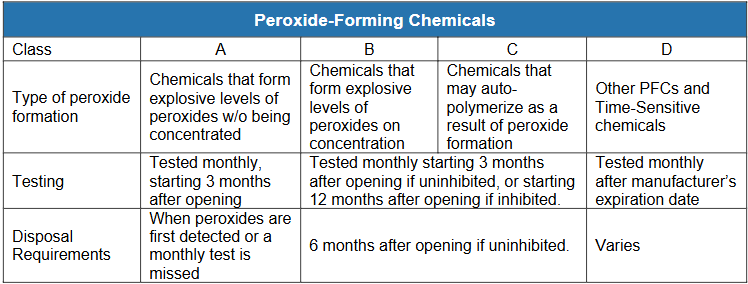
Review all cautionary material supplied by the manufacturer prior to use. Ensure that containers are tightly sealed to avoid evaporation and that they are free of exterior contamination or crystallization. Never return unused quantities back to the original container and clean all spills immediately. The table below summarizes the four classes of peroxide-forming chemicals and their requirements.
Class A Peroxide-Forming Chemicals
Class A peroxide-forming chemicals form explosive levels of peroxides after prolonged storage, even without being concentrated. These must be tested monthly for peroxides starting three months after opening and disposed when peroxides are first detected, or if more than one month elapses between tests.
- Isopropyl ether
- Divinyl ether
- Potassium metal
- Vinylidene chloride
- Chloroprene
- Tetrafluoroethylene
- Divinyl acetylene
- Potassium amide
- Sodium amide
- Butadiene
- Potassium Metal
Class B Peroxide-Forming Chemicals
This group of chemicals will readily form peroxides that become explosive when concentrated (e.g., via evaporation or distillation). The concentration process removes or inactivates most auto-oxidation inhibitors. As a result, uninhibited Class B peroxide-forming chemicals should be disposed of within 6 months of opening and tested monthly for peroxides starting 3 months from opening. Inhibited Class B peroxide-formers should be tested monthly starting 12 months from opening and disposed of within 18 months of receipt. If using under conditions where peroxides might become dangerously concentrated (i.e. distillation or rotovaping), additionally test before use.
- Acetaldehyde
- 1,1-Dimethoxymethane
- 1-Phenylethanol
- 2-Methyl-1-butanol
- 2-propanol
- 4-penten-1-ol
- Allyl Ether
- Benzyl Ether
- Cumene
- Cyclooctane
- Diallyl Ether
- Dimethoxyethane (glyme)
- Di-n-propoxymethane
- isophorone
- Methylcyclopentane
- p-isopropoxypropionitrile
- Vinyl ethers
- Diethyl ether
- 1,2-Epoxy-3-isopropoxy propane
- 2-Butanol
- 2-Penten-1-ol
- 4-heptanol
- Acetal
- Benzyl alcohol
- Benzyl Ethyl Ether
- Cyclohexene
- Decahydronpthalene
- Dicyclopentadiene
- Diethoxymethane
- Ethylene Glycol Dimethyl Ether
- Methyl Isobutyl ketone
- Other secondary alcohols
- Tetrahydrofuran
- Furan
- 4-Methyl-2-pentanone
- 1,2-Dibenzyloxyethane
- 2-Hexanol
- 2-Phenylethanol
- 4-Methyl-2-pentanol
- Acetaldehyde
- Benzyl n-butyl Ether
- Benzyl 1-naphthyl Ether
- Cyclopentene
- Diacetylene
- 1,4-Dioxane
- Diethyl acetal isoamyl benzyl ether
- Isoamyl ether
- Methyl Acetylene
- p-Dibenzyloxybenzene
- Tetrahydronaphthalene
Class C Peroxide-Forming Chemicals
This group of chemicals forms peroxides that can initiate violent autopolymerization. When stored in a liquid state, the peroxide-forming potential dramatically increases. These chemicals should be disposed of or used within 6 months of opening, and tested monthly for peroxides starting 3 months from opening if uninhibited.
- Acrylic acid
- Acrylonitrile
- Butadiene
- Chlorobutadiene
- Vinylidene Chloride
- Vinyl chloride (chloroethene)
- Chlorotrifluoroethylene
- Methyl methacrylate
- Styrene
- Tetrafluoroethylene
- 2-vinyl pyridine
- 1,1-Dichloroethene
- Vinyl acetate
- Vinylacetylene
- 2-Vinylpyridine
- 4-vinyl pyridine
Class D Peroxide-Forming Chemicals and Other Time-Sensitive Chemicals
This group of chemicals may form peroxides or other hazardous products, but cannot clearly be defined as Class A, B, or C. These chemicals have varied timeframes regarding disposal and use. Class D PFCs should be disposed of or used within 12 months of opening and tested based on manufacturer’s recommendations. Other TSCs listed such as alkali metals and chloroform have storage and use guideline found in the information in previous paragraphs within this chapter. If you have questions, please contact Chemical Safety by email at labsafety@ehs.ucla.edu.
- Acetylene
- Ammonium Perchlorate
- 1-(2-Chloroethoxy)-2-phen-oxyethane
- Chloroform
- Ethylene oxide
- Hexanitrostilbene
- Hydrogen Compound Gases
- Nitrogen trichloride
- Nitroguanidine
- 1-(2-Ethoxyethoxy)ethyl acetate
- 1,1,2,3-Tetrachloro-1,3-butadiene
- 1,1-Dimethoxyethane
- 1,2-Bis(2-chloroethoxy)ethane
- 1,2-Dibenzyloxyethane
- 1,2-Dichloroethyl ethyl ether
- 1,2-Diethoxyethane
- 1,2-Epoxy-3-isopropoxypropane
- 1,2-Epoxy-3-phenoxypropane
- 1,3,3-Trimethoxypropene
- 1,3-Butadiyne
- 1,3-Dioxepane
- 1,5-p-Methadiene
- 1-Ethoxy-2-propyne
- 1-Ethoxynaphthalene
- 1-Octene
- 1-Pentene
- 2,2-Diethoxypropane
- 2,4-Dichlorophenetole
- 2,4-Dinitrophenetole
- 2,5-Hexadiyn-1-ol
- 2-Bromomethyl ethyl ether
- 2-Chlorobutadiene
- 2-Ethoxyethyl acetate
- 2-Ethoxyethyl)-o-benzoyl benzoate
- 2-Ethylacrylaldehyde oxime
- 2-Ethylbutanol
- 2-Ethylhexanal
- 2-Methoxyethanol
- 2-Methoxyethyl vinyl ether
- 2-Methyltetrahydrofuran
- 3,3-Dimethoxypropene
- 3-Bromopropyl phenyl ether
- 3-Ethoxyopropionitrile
- 3-Methoxy-1-butyl acetate
- 3-Methoxyethyl acetate
- 4,5-Hexadien-2-yn-1-ol
- 4-Methyl-2-pentanone
- 4-Vinyl cyclohexene
- Acrolein
- Allyl ether
- Allyl ethyl ether
- Ammonium Nitrate
- Ammonium Picrate
- Allyl phenyl ether
- Dinitrotoluene
- Germanium
- Hydrazine
- Lead styphnate
- Nitroglycerin
- Nitrourea
- å-Phenoxypropionyl chloride
- Benzyl 1-naphthyl ether
- Benzyl ether
- Benzyl ethyl ether
- Benzyl methyl ether
- Benzyl n-butyl ether
- Bis(2-(methoxyethoxy)ethyl) ether
- Bis(2-chloroethyl) ether
- Bis(2-ethoxyethyl) adipate
- Bis(2-ethoxyethyl) ether
- Bis(2-ethoxyethyl) phthalate
- Bis(2-methoxyethyl) carbonate
- Bis(2-methoxyethyl) ether
- Bis(2-methoxyethyl)phthalate
- Bis(2-methoxymethyl) adipate
- Bis(2-n-butoxyethyl) phthalate
- Bis(2-phenoxyethyl) ether
- Bis(4-chlorobutyl) ether
- Bis(chloromethyl) ether
- Buten-3-yne
- Chloroacetaldehyde diethylacetal
- Chloroethylene
- Chloromethyl methyl ether
- Cyclooctene
- Cyclopropyl methyl ether
- Di(1-propynyl) ether
- Di(2-propynyl) ether
- Diallyl ether
- Diethoxymethane
- Diethyl acetal
- Diethyl ethoxymethylenemalonate
- Diethyl fumarate
- Diethylketene
- Dimethoxymethane
- Dimethylketene
- Di-n-propoxymethane
- Ethoxyacetophenone
- Ethyl ß-ethoxypropionate
- Ethyl vinyl ether
- Furan
- Isoamyl benzyl ether
- Isoamyl ether
- Picric Acid
- Calcium Nitrate
- Isobutyl vinyl ether
- Dinitrophenol
- Hexanitrodiphenylamine
- Hydrazoic acid
- Nitrogen triiodide
- Nitroglycol
- Perchloric acid
- Isophorone
- Isopropyl2,4,5-trichlorophenoxyacetate
- Limonene
- m,o,p-Diethoxybenzene
- Methoxy-1,3,5,7-cyclooctatetraene
- Methyl p-(n-amyloxy)benzoate
- m-Nitrophenetole
- n-Amyl ether
- n-Butyl phenyl ether
- n-Butyl vinyl ether
- n-Hexyl ether
- n-Methylphenetole
- n-Propyl isopropyl ether
- n-Propylether
- o,p-Ethoxyphenyl isocyanate
- o,p-Iodophenetole
- o-Bromophenetole
- o-Chlorophenetole
- Oxybis(2-ethyl acetate)
- Oxybis(2-ethyl benzoate)
- p-(n-Amyloxy)benzoyl chloride
- p-Bromophenetole
- p-Chlorophenetole
- p-Dibenzyloxybenzene
- p-Di-n-butoxybenzene
- Phenoxyacetyl chloride
- Phenyl o-propyl ether
- p-Isopropoxypropionitrile
- p-Phenylphenetone
- Sodium 8,11,14-eicosatetraenoate
- Sodium ethoxyacetylide
- ß,ß-Oxydipropionitrile
- ß-Bromophenetole
- ß-Chlorophenetole
- ß-Methoxypropionitrile
- tert-Butyl ethyl ether
- tert-Butyl methyl ether
- Tetrahydropyran
- Triethylene glycol diacetate
- Triethylene glycol dipropionate
- Vinylenecarbonate
- Vinylidene chioride
If old containers of time-sensitive chemicals are discovered in the laboratory, (greater than two years past the expiration date or if the date of the container is unknown), do not handle the container. If crystallization is present in or on the exterior of a container, do not handle the container. Secure it and contact the EH&S Hotline at 310-825-9797 for pick-up and disposal.
Disposal of expired peroxide-forming chemicals may incur a charge of $100 (minimum) per container. When disposing of these chemicals, the laboratory must complete a recharge order request form. Disposal of any peroxide-forming chemical with a peroxide concentration greater than 20ppm cannot be done through normal campus disposal and may require additional fees if a high hazard waste team is required. More information on removal of peroxides can be found in wastes that require special handling.