
Laboratory Chemicals Regulated by the EPA
The United States Environmental Protection Agency (EPA), under the Toxic Substances Control Act (TSCA), has determined that methylene chloride, also known as dichloromethane (DCM), and trichloroethylene (TCE) pose unreasonable risk of injury to health when used as laboratory chemicals. Cumulative exposures to DCM can cause cancer and damage to the liver and kidneys. Acute exposures to high concentrations of DCM vapor in poorly-ventilated spaces has caused central nervous system harm, up to and including unconsciousness and death through respiratory paralysis. Use of TCE as a laboratory chemical has been banned, with some limited exceptions, because the limit of detection is higher than the exposure level the EPA has deemed to be safe. Requests to use TCE under one of these exemptions must be made in writing to the CHO and may be sent to chemsafety@ehs.ucla.edu.
A Workplace Chemical Protection Program is required for those entities that will continue using DCM under these allowable uses. UCLA has implemented the following requirements to satisfy this obligation.
Definitions, Roles and Responsibilities
- As needed monitoring - Exposure measurements taken when there is a change of use.
- De minimis - The threshold concentration for which the regulatory restrictions are not required. For DCM this concentration is 0.01% by weight.
- Exposure Control Plan (ECP) - This documents actions taken to mitigate occupational exposures and comply with the WCPP.
- Owners / operators - Anyone who owns, leases, operates, controls, or supervises a workplace. This includes UCLA and each PI, instructor, or supervisor who oversees a location where DCM is used or a person who uses DCM. UCLA is responsible for writing and updating this Program. PIs, instructors, and supervisors are responsible for implementing this Program and for approving and enforcing any Exposure Control Plans applicable to their work area.
- Periodic monitoring - Dependent upon the results of the initial and/or repeat monitoring; the frequency for gathering new monitoring data ranges from 3 months to 5 years.
- Potentially exposed person - Any person who may be exposed to a chemical or mixture in a workplace as a result of a condition of use of that chemical substance or mixture. This applies regardless of whether a person is a user of the chemical or an employee. Potentially exposed persons are responsible for complying with the provisions of this Program.
- Prohibited Uses - the EPA has established exposure limits for DCM for some conditions of use, including “use as a laboratory chemical.” Nearly all other commercial and industrial uses, such as use as a solvent or paint remover, are prohibited. EPA has a full list of prohibited uses in its Guide to Complying with the 2024 Methylene Chloride Regulation.
- Regulated area - An area demarcated where airborne concentrations exceed, or there is a reasonable possibility they may exceed, the Existing Chemical Exposure Limit (ECEL) of 2 ppm or EPA Short Term Exposure Limit (STEL) of 16 ppm.
- Retailer - An entity that distributes or makes available products to consumers.
- Time-Weighted Average (TWA) - The potentially-exposed person's average airborne exposure in any 8-hour work shift of a 40-hour work week (8-hour TWA), or in any 15-minute reference period covering a specific task where airborne concentrations may instantaneously exceed the full-shift exposure limit (15-minute TWA).
- Workplace Chemical Protection Program (WCPP) - A written program to protect potentially exposed persons in the workplace who are engaged in conditions of use that are not prohibited
Exposure Limits
Under this program, long-term exposures to DCM will be kept below 2 ppm (8-hour TWA) and short-term exposures will be kept below 16 ppm (15-minute TWA). Additional monitoring will be implemented whenever long-term exposures exceed 1 ppm (8-hour TWA). Any deviation from these limits must be approved by the Chemical Hygiene Officer and will be documented in a written Exposure Control Plan. This documentation will include a respiratory protection program to be implemented in work areas receiving a variance.
Exposure Monitoring
Monitoring requirements
Initial monitoring for DCM is required to establish a baseline for DCM users and to inform the development of the Exposure Control Plan (ECP). All initial monitoring shall be conducted by May 5, 2025, or within 30 days after the introduction of DCM in the workplace. Initial monitoring results will be used to determine the frequency of compliance activities such as periodic monitoring. Monitoring must be taken when and where operating conditions are best representative of each potentially exposed person’s highest likely full shift and 15-minute exposures occur.
Exemptions to Initial Monitoring
Initial monitoring may not be performed under this Program if exposure to DCM is less than 30 days per year with two conditions:
- Direct reading measurements must be taken in the environment to ensure levels are below both 1 ppm (8-hour TWA) and 16 ppm (15-minute TWA), and
- Appropriate controls must be put in place to ensure levels remain below exposure limits.
The Chemical Hygiene Officer must verify in writing that these conditions have been satisfied.
Initial and Periodic Monitoring
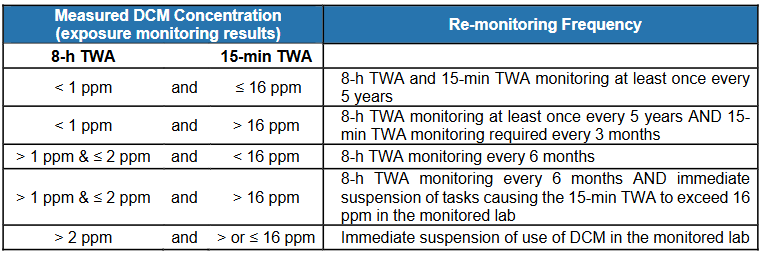
The results of initial monitoring will determine how frequently periodic monitoring must occur. Periodic monitoring can range from every 3 months, every 6 months or every 5 years depending on the following conditions:
Changes in Conditions
The frequency of periodic monitoring may be reduced if two consecutive samples taken at least 7 days apart show the 8-hour TWA exposure has decreased from between 1 and 2 ppm to below 1 ppm. Lifting of a suspension of DCM use similarly requires that two consecutive samples taken at least 7 days apart show the 8-hour TWA exposure has decreased to below 2 ppm AND that the 15-minute TWA exposure has decreased to below 16 ppm.
Suspension of Periodic Monitoring
Monitoring may be suspended if work with DCM will not occur during the timeframe where monitoring would be required under this plan. In this case, the next use of DCM must be monitored. The PI, instructor, or lab supervisor who oversees the location where DCM is used is responsible for notifying EH&S in advance, and may not proceed with use of DCM until monitoring has been scheduled.
Sampling Requirements
The following sampling guidelines must be followed for every potentially exposed person:
- Sampling requirements
- Sampling must be conducted for every potentially exposed person or a representative sample representing all exposed persons.
- Sampling must be taken when and where the operating conditions are representative of full shift exposures.
- All workers must be given the opportunity to observe exposure monitoring
- Must be taken at the personal breathing zone
- Notification of monitoring results to monitored person and potentially exposed persons (e.g., similar exposure group) within 15 working days after receipt of results
- Sampling Report:
- Provide the ECEL, action level, EPA STEL, and significance of each.
- Provide the quantity, location, and manner of DCM use at the time of monitoring.
- Provide the monitoring results
- Whether the concentration exceeds the ECEL, action level, and EPA STEL.
- A description of actions taken to reduce exposure to below exposure limits.
- A description of the respiratory protection measures if needed
- Any identified releases of DCM during monitoring
Regulated Areas
A regulated area must be established wherever airborne concentrations of DCM exceed, or could reasonably be expected to exceed, the ECEL of 2 ppm or STEL of 16 ppm based on monitoring. Regulated areas are only allowed by variance under this Program, with additional required controls as outlined below.
Establishing Regulated Areas
Regulated areas must be established and clearly demarcated by signage indicating use of DCM in the area. Signage serves to alert potentially exposed persons of the boundaries of the area and minimizes the number of exposed persons.
The exact wording will be tailored for each area, and may be in multiple languages as needed. An example of acceptable wording is the following:
Methylene Chloride Warning
Authorized Personnel Only
Airborne Concentrations may exceed:
ECEL: 2 ppm
STEL: 16 ppm
Avoid Exposure
Follow Safety Protocols
Respiratory Protection Required When Methylene Chloride is in Use
Access Control
Only authorized personnel may enter a regulated area. These personnel must receive DCM-specific training, including hazard communication, safe handling practices, emergency procedures, and proper use of PPE prior to entering the regulated area.
Respiratory Protection
A NIOSH Approved Supplied-Air Respirator (SAR) or Self-Contained Breathing Apparatus (SCBA) is required to enter a regulated area. EHS assesses each use case and determines the appropriate respiratory protection based on the EPA rule as part of UCLA’s Respiratory Protection Program.
Exposure Control Plan
Elimination
Use of DCM is allowed under this Program as a laboratory chemical and in waste operations to dispose of materials generated through use as a laboratory chemical. These uses cannot be eliminated at UCLA because of DCM’s unique chemical properties and in order to ensure results from ongoing experiments can be compared with previously-obtained experimental results. In accordance with EPA regulation, all uses not explicitly permitted under this Program shall be eliminated.
Substitution
The following substitutes have been considered for dichloromethane;
- 2-Methyltetrahydrofuran
- Cyclopentylmethyl ether
- Methyl tert-butyl ether
- Methyl isobutyl ketone
- Toluene
- Ethyl acetate
- Methanol
- Ethanol
- Isopropanol
- Other ___________________________
They have been deemed inadequate for the following reason(s);
- Undesirable cross-reactivity
- Poor match for polarity
- Poor match for density
- Boiling point too high
- Need to maintain reproducibility of established procedure
- Other _____
Personal Protective Equipment
Dichloromethane may only be handled while wearing the following PPE:
- Eye Protection
- Safely glasses
- Goggles
- Face shield
- Other ____________
- Skin Protection
- Lab coat
- Apron
- Other ____________
- Hand Protection
- Nitrile gloves (Double gloved)
- Polyvinyl alcohol gloves
- LLDPE gloves
- Viton gloves
- ilvershield gloves
Lab/Shop-Specific ECPs
The template on the following two pages may be used to complete an Exposure Control Plan (ECP) for specific uses of DCM. Each Principal Investigator (PI) and/or Supervisor is responsible for developing, reviewing, and approving ECPs for all procedures that use DCM in locations they are responsible for. One ECP may cover more than one procedure so long as all control measures are consistent across all covered procedures.
A printable version of the SOP can be found here.
Engineering Controls
Dichloromethane will be used with the following engineering controls in place:
- Local Exhaust Ventilation (select one)
- Fume hood
- Glove box
- Exhausted enclosure
- Snorkel
- Splash shield
- Other ___________________________
Administrative Controls
All occupants of INSERTLABROOM shall review this WCPP and ECP prior to entry and sign that they have received the information they contain and agree to abide by the training provided to them.
Dichloromethane is approved for use in INSERTLABROOM in INSERTUSELOCATION(S). Dichloromethane is approved for storage in INSERTLABROOM in INSERTSTORAGELOCATION(S).
Stop all use of dichloromethane if any malfunction of the local exhaust ventilation device indicated above is suspected and contact EHS.
Any PPE suspected of coming in contact with dichloromethane must be changed immediately.
Training and Information
The EPA rule includes requirements for training and also references the OSHA Methylene Chloride Standard training requirements; both EPA and OSHA reference general training requirements (e.g., nature of training required, frequency, etc.) as well as task-specific training. As such, training will be provided through a combination of Worksafe courses and lab-directed training by PIs, instructors, and supervisors who oversee the assignment of tasks in the lab. All individuals who perform research activities in a laboratory room where DCM is used are required to complete these trainings.
Hazards of Dichloromethane
Cumulative exposures to DCM can cause cancer and damage to the liver and kidneys. Acute exposures to high concentrations of DCM vapor in poorly-ventilated spaces has caused central nervous system harm, up to and including unconsciousness and death through respiratory paralysis. Direct exposure to skin and eyes can cause irritation.
Worksafe Training
The Laboratory Safety Fundamentals training course in Worksafe covers hazard identification using chemical labels and Safety Data Sheets and common aspects of PPE training including glove selection, use, donning, doffing, and what to do in the event of contamination. The Chemical Hygiene Plan training course in Worksafe verifies that everyone who works in a research laboratory has read this Chemical Hygiene Plan, including this WCPP. These trainings are repeated annually.
Lab/Shop-Specific Dichloromethane Training
Each PI, instructor, and/or supervisors who oversees the assignment of tasks requiring the use of DCM in the lab shall implement, and document in their lab-specific Exposure Control Plan(s), hands-on training for lab personnel, covering:
- Task or activity-specific PPE required and location of PPE.
- Exposure controls required during tasks with DCM, and training on how to use those controls (e.g., appropriate fume hood sash level).
- The PI, instructor, or supervisor shall ensure that only individuals trained on DCM safety are allowed to perform DCM tasks.
If tasks are modified or new tasks are initiated, the PI, instructor, or supervisor shall notify the Chemical Hygiene Officer as additional DCM monitoring may be required.
Recordkeeping
Compliance records must be retained for a period of five years. Owners and operators, including each PI, instructor, or supervisor who oversees a location where DCM is used or a person who uses DCM, are required to participate in generation and maintenance of these records, as they are crucial in proving adherence to the restrictions set forth by the EPA. It is acknowledged that many of these records and documentation are already maintained by UCLA and by individual research groups associated with overlapping programs such as Medical Surveillance, Training and Chemical Hygiene program elements:
- Exposure Control Records: These records will be maintained by their generator as specified below.
- Lab-specific Exposure Control Plans will be maintained by each PI, instructor, or supervisor who oversees a location where DCM is used or a person who uses DCM.
- Implementation records, including inspections, evaluations and exposure control updates, as well as confirmation that affected persons are properly implementing exposure controls, will be maintained by UCLA EH&S.
- Documentation of Personal protective equipment being used as part of the program will be maintained by each PI, instructor, or supervisor who oversees a location where DCM is used or a person who uses DCM.
- Training records for Lab Safety Fundamentals and the Chemical Hygiene Plan will be maintained by UCLA EH&S.
- Lab-specific training records will be maintained by each PI, instructor, or supervisor who oversees a location where DCM is used or a person who uses DCM.
- Maintenance, shutdown or malfunction documentation for facility exposure controls that cause air concentrations to exceed the ECEL or STEL will be maintained by UCLA EH&S. Each PI, instructor, or supervisor who oversees a location where DCM is used or a person who uses DCM is responsible for notifying UCLA EH&S immediately when such events are suspected to have occurred.
- Exposure Monitoring Records: Monitoring records will be maintained by UCLA EH&S for employees that may be potentially exposed including:
- All measurements made to determine conditions affecting monitoring results, including copies of the notifications to the potentially exposed persons
- The identities of all potentially exposed persons whose exposure was not measured and whose exposure is intended to be represented by the monitoring
- Description of analytical methods
- Information on air monitoring equipment, including calibration dates, limits of detection and malfunctions
- Objective data being used to forgo initial exposure monitoring including: the use being evaluated, the source of the data, the measurement methods and results, and any other relevant information.
- Records related to any eligible exemptions will be maintained by UCLA EH&S.