
Hazard Determination
For materials obtained outside the laboratory, PIs/Laboratory Supervisors may rely on the hazard determination of the manufacturer. PIs/Laboratory Supervisors are responsible for determining if any items produced in their laboratories display any of the aforementioned hazards.
The term “hazardous substance” refers to any chemical for which there is statistically significant evidence based on at least one study conducted in accordance with established scientific principles that acute or chronic health effects may occur in exposed individuals. PIs/Laboratory Supervisors may assume that any chemical of known composition produced in their lab is hazardous if it’s listed in the following:
- “The Hazardous Substance List (8 CCR §339)”, commonly known as the Directors List of Hazardous Substances;
- “Toxic and Hazardous Substances, Air Contaminants (8 CCR §5155)”;
- “Threshold Limit Values for Chemical Substances in the Work Environment", ACGIH, 2009;
- “Fourteenth Annual Report on Carcinogens”, NTP, 2016;
- “Monographs”, IARC, WHO; or
- “Chemicals Known to the State to Cause Cancer or Reproductive Toxicity” (Proposition 65, 22 CCR §12000).
Any chemical of unknown composition should be presumed to be hazardous. Chemical derivatives of known materials should be presumed to be at least as hazardous as their parent compound. In all such cases, PIs/Laboratory Supervisors should take appropriate steps to prevent exposure.
Chemical Hazard Communication
Chemical Labeling
Chemical labels are your first source of information on the hazards of a given material. Every chemical found in the laboratory must be properly labeled. Labeling requirements for all hazardous substances are summarized as follows:
- All containers of hazardous materials must be labeled with the identity of any hazardous substance(s)
- The label must contain all applicable hazard warning statements
- The name and contact information of the chemical manufacturer, generator, or other responsible party must be present
- Manufacturer’s product labels must remain on all containers, and must not be defaced in any way. Appropriate hazard warning statements must be present, if not that information must be added
- Each container should be labeled with the date it was produced in the lab, received from the manufacturer, and/or first opened. This is mandatory for peroxide-forming chemicals.
- Labels must be legible, in English, and prominently displayed
- Symbols and/or other languages are required for non-English speaking employees as needed to effectively communicate hazard information
- Daily use containers (such as spray bottles) must be labeled with the identity of the substance and appropriate hazard warnings
Particularly Hazardous Substances have additional requirements. Printable safety labels (see Figure 3.1) are available on the UCLA Chemistry website which identify the specific hazard associated with each of these chemicals (carcinogen, reproductive toxicant, acute toxicant). Labs are also free to develop their own labeling systems. Contact EH&S at chemsafety@ehs.ucla.edu for guidance on developing an acceptable internal system. In addition, the storage area where PHS are kept must be labeled with the type of hazard. These chemicals should be segregated from other chemicals to help with proper access control and hazard identification.
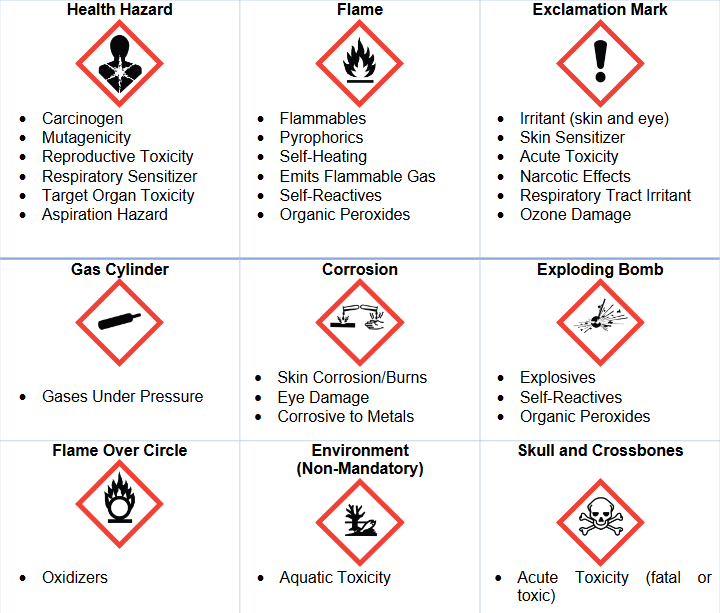
Pictograms are a central component of the Globally Harmonized System of hazard communication. Their use to indicate chemical hazards has been described previously in this chapter. Labs are encouraged to utilize GHS-compliant labeling for user-generated materials. Hazardous materials generated for use outside of the immediate lab area, including any materials to be shipped off campus, are required to be labeled according to GHS. Contact EH&S at chemsafety@ehs.ucla.edu for assistance with generating GHS-compliant labels.
Safety Data Sheets (SDS)
An SDS must be available for each hazardous substance in a laboratory’s chemical inventory. SDSs are available from UC Risk and Safety Solutions. This resource is accessible from any computer on the UCLA network by navigating to UC Risk and Safety Solutions. PIs/Laboratory Supervisors are responsible for keeping SDSs current and making them available to all laboratory employees throughout the work day. SDSs must be in a central location that can be accessed immediately in the event of an emergency. Electronic copies may be kept in a file on a group computer or drive, or hard copies maintained in a central location in the laboratory.
New chemical substances synthesized or produced in a laboratory and used or shared outside of that laboratory suite, require the preparation of an SDS for each such substance. Contact EH&S at chemsafety@ehs.ucla.edu for more information on preparing SDSs.
The format and required content of a SDS have been standardized under the Globally Harmonized System. Chemical manufacturers are required to provide updated SDSs. The minimum information required for an SDS is:
- Identification of the substance or mixture and of the supplier
- Hazards identification
- Composition/information on ingredients
- First aid measures
- Firefighting measures
- Accidental release measures
- Handling and storage
- Exposure controls/personal protection
- Physical and chemical properties
- Stability and reactivity
- Toxicological information
- Ecological information
- Disposal considerations
- Transport information
- Regulatory information
- Other information including information on preparation and revision of the SDS
Door Cards
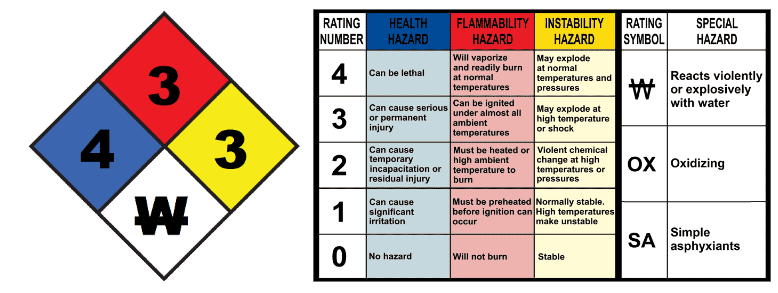
Rooms containing hazardous chemicals must be labeled with a National Fire Prevention Association (NFPA) door placard that gives an overview of the key chemical hazards contained within that room. These postings contain the NFPA fire diamond which indicates the maximum level of health hazard, fire hazard, and reactivity hazard within, as well as information regarding certain special hazards. Each of the first three sections contain a numerical rating from 0 to 4 that quickly supplies the level of hazard. Under the NFPA system a score of 0 indicates a low level of hazard and 4 indicates the highest hazard level. The three main chemical hazard types correspond to the three colored areas: red indicates a flammability hazard, yellow indicates a reactive hazard, and blue indicates a health hazard. The white area at the bottom of the diamond is reserved for special hazards which are of particular relevance to first responders such as water-reactive chemicals, oxidizers, and simple asphyxiants. Figure 3.2 illustrates the NFPA rating system. EH&S provides door cards which contain the NFPA Fire Diamond to all laboratory spaces on campus. In addition to chemical hazard information, they also provide emergency contact information in the event that first responders require additional information about a lab in order to safely enter.
To request a door card or a door card holder, fill out the Door Card Request Form or email doorcards@ehs.ucla.edu.