
How to Reduce Exposure to Hazardous Chemicals
Exposure routes
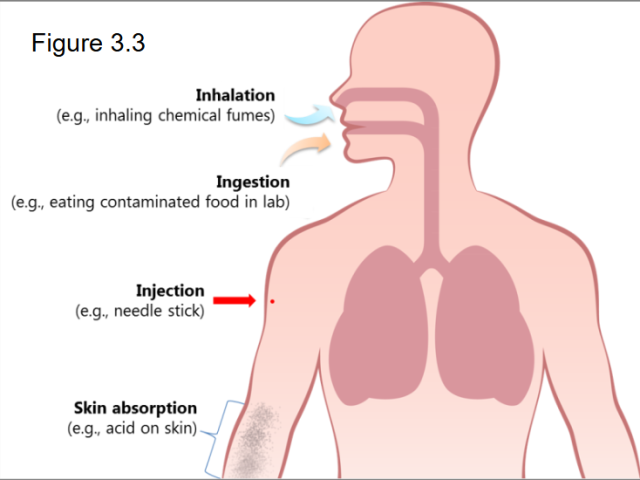
There are four primary routes of exposure for chemicals which have associated health hazards (illustrated in Figure 3.3):
- Inhalation;
- Ingestion;
- Absorption (through the skin or eyes); an
- Injection (skin being punctured by a contaminated sharp object or uptake through an existing open wound).
Of these, the most likely route of exposure in the laboratory is by inhalation. In addition to being the most likely route of exposure, inhalation can provide some materials with direct access to the bloodstream and/or central nervous system. The inhalation route can also result in ingestion secondary to inhalation if inhaled materials become entrapped in mucus or saliva that become swallowed. Many hazardous chemicals may affect people through more than one of these exposure routes, so it is critical that protective measures are in place for each of these uptake mechanisms.
Control measures
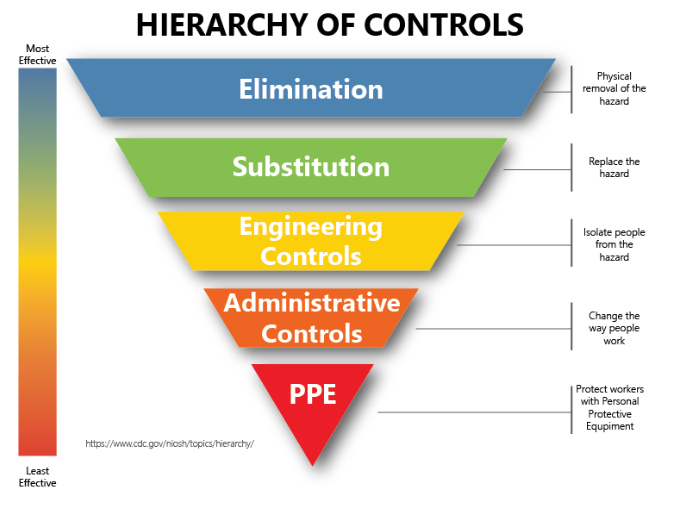
Hazardous chemicals require a carefully considered, multi-tiered approach to ensure safety. Safety controls can be divided into five classifications, which are ordered according to their effectiveness:
- Elimination;
- Substitution;
- Engineering Controls;
- Administrative Controls; and
- Protective Apparel and Equipment
Elements of these five types of control are used in a layered approach to create a safe working environment. The principles of each of these elements are detailed below.
Elimination and Substitution
The most effective method for mitigating a risk is to remove the hazard from the workplace entirely. When this is impractical, the next-best method is to replace the hazard with one which is less severe or less likely to impact someone. Examples of substitution include replacing mercury thermometers with alcohol thermometers, using disposable plastic serological pipettes instead of glass, and using Luer-Lock syringes instead of Luer-slip syringes.
Engineering Controls
Engineering controls include all “built in” safety systems. These controls offer the first line of protection after opportunities for elimination and substitution have been exhausted. They are highly effective in that they generally require minimal special procedures or actions on the part of the user except in emergency situations. A fundamental and very common example is the laboratory fume hood, which is very effective at containing chemicals and protecting users from inhalation hazards. Other examples of engineering controls include general room ventilation, flammable material storage units, and secondary containment.
General Laboratory Ventilation
All laboratory rooms in which hazardous materials are used must have fresh air ventilation with 100% of the exhaust venting to the outside; laboratory rooms should not be part of recycled air systems. In cases where this is not desirable, a formal hazard evaluation will be made by EH&S to determine what work can be done in the space and under what special conditions or limitations. Laboratory rooms should be kept at negative pressure compared to public areas to prevent the spread of hazardous vapors. See the University of California Environment, Health and Safety (EH&S) Laboratory Safety Design Guide for additional information on laboratory ventilation.
Fume Hoods
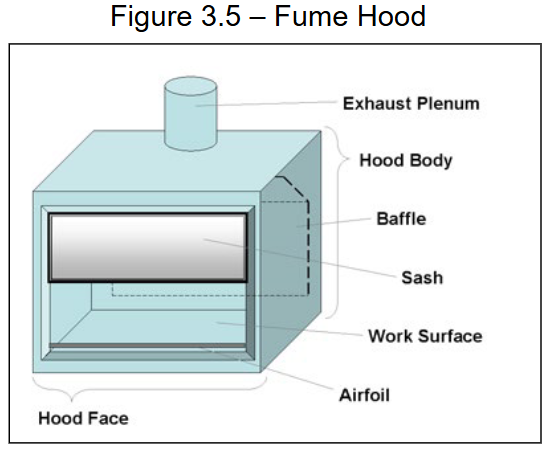
Fume hoods are the most commonly used local exhaust system on campus, and are one of the most important pieces of equipment used to protect laboratory and other workers from exposure to hazardous chemicals. Some systems are equipped with air cleaning devices (HEPA filters or carbon absorbers). Figure 3.5 displays the key components of a ducted fume hood.
General Rules for Fume Hood Use
The following general rules should be followed when using laboratory hoods:
- Fume hoods should not be used for work involving hazardous substances unless they have a certification label that confirms certification has occurred within the past year
- Always keep hazardous chemicals >6 inches behind the plane of the sash
- Never put your head inside an operating laboratory hood. The plane of the sash is the barrier between contaminated and uncontaminated air.
- Work with the hood sash in the lowest practical position. The sash acts as a physical barrier in the event of an accident. Keep the sash closed when not conducting work in the hood.
- Do not clutter your hood with unnecessary bottles or equipment. Keep it clean and clear. Only materials actively in use should be in the hood.
- Do not make any modifications to hoods, duct work, or the exhaust system without first contacting EH&S at chemsafety@ehs.ucla.edu
- Do not use large equipment in laboratory hoods unless the hood is dedicated for this purpose, as large obstructions can change the airflow patterns and render the hood unsafe.
- To get re-certified, email fumehoods@ehs.ucla.edu with fume hood location(s) and contact information.
It is advisable to use a fume hood when working with all hazardous substances. In addition, a fume hood or other suitable containment device must be used for all work with particularly hazardous substances if there is a likelihood of workers exceeding regulatory exposure limits. This includes particularly hazardous solids that are toxic by inhalation. Weigh toxic solids by transferring the desired amount into a tared vial in a fume hood, sealing it, weighing the vial plus reagent, and recording the mass by difference. If your protocol does not permit the handing of such materials in a fume hood, contact EH&S to determine whether additional respiratory protection is warranted. For questions regarding exposure limits contact EH&S at indhyg@ehs.ucla.edu and for questions regarding alternative engineering controls (such as a snorkel hood, ductless fume hood, etc.), and for assistance in conducting a hazard assessment for uncontained procedures, contact EH&S at chemsafety@ehs.ucla.edu. Ductless fume hoods are generally not permitted; however, they may be used for limited applications and require prior approval from EH&S. A properly operating and correctly used fume hood can reduce or eliminate gases from volatile liquids, dusts and mists.
Fume Hood Evaluations
Fume hoods are evaluated for operation and certified on an annual basis. These annual evaluations check the fume hood air flow velocity to ensure that the unit will contain hazardous vapors. Data on annual fume hood monitoring is maintained by EH&S. A complete report of fume hood monitoring data must be kept for one year; summary data must be maintained for 5 years. Chemical fume hoods should be inspected outside of the annual inspection process upon installation, renovation, when a deficiency is reported, or a change has been made to the operating characteristics of the hood.
Each fume hood should have a current calibration sticker and a marker indicating the highest sash height to be used when working with hazardous materials. Contact EH&S at fumehoods@ehs.ucla.edu for a hood evaluation if these labels are missing. Air flow for fume hood ventilation is measured at nine points. The average of the nine readings must be at least 100 linear feet per minute (lfm) with a minimum of 70 lfm for any measurement. The average face velocity should not exceed 160 lfm.
Inspections
- Physical Inspection: Evaluates the physical condition of the hood and the materials being used in the hood. This includes checking for:
- Improper storage of materials inside the fume hood
- Use of proper materials
- General hood cleanliness
- Physical damage to the hood (e.g., broken sash)
- Fully functioning lighting, fume hood indicator, airflow monitor, and alarm
- Hood Performance Inspection: Evaluates the overall hood performance to ensure that it is functioning properly. This involves checking the:
- Average and minimum face, which is used to determine the rating of the hood and what the hood can be used for Noise generated by the fume hood, to ensure that it is below 85 dB (only upon request)
- If fume hood does not pass inspection, it will be labeled with a "DO NOT USE" sign until it can be repaired.
Each fume hood must be equipped with at least one type of continuous quantitative monitoring device designed to provide the user with current information on the operational status of the fume hood. Many fume hoods also have motion sensors to determine when they are not in active use. These sensors will reduce the fume hood’s air flow as part of the campus’ energy savings effort. When hazardous materials are in a fume hood, but it is not under active use (e.g., during an unattended reaction or experiment), the sash should be closed. Fume hoods are not designed for storage.
Do not use a fume hood that appears to be malfunctioning. Routine maintenance and repairs of fume hoods are conducted by Facilities Management. Fume hood users may route requests for hood repair directly to Facilities by placing a Facilities Service Request or by calling (310) 825-9236. Make sure to indicate that the FSR has been “generated as a result of a health and safety deficiency” and mark it “urgent” in order to expedite processing. Remove open containers of hazardous chemicals from the fume hood and place signage on the sash marking it out of order. EH&S does not initiate maintenance but will coordinate with Facilities Management to ensure that it is completed. Upon reported completion of maintenance or repairs by Facilities, EH&S will re-inspect the fume hood.
Fume hoods used for Listed Carcinogens have additional requirements. Contact EH&S at chemsafety@ehs.ucla.eduif your lab intends to begin using such materials.
Non-ducted fume hoods have additional requirements:
- A statement from the manufacturer that the filter(s) installed in the hood are effective for the listed materials
- A preventative maintenance contract that covers re-certification and filter changes per manufacturers’ recommendations
- The list of approved materials to be posted on the hood
- Users to receive training on the proper use and limitations of the hood
Ventilation Devices and Glove Boxes
In cases where a fume hood is unavailable or would be impractical, a number of other engineering controls may be employed, including vented enclosures for large pieces of equipment or chemical storage and portable exhaust/filtration systems for capturing contaminants near the point of release. For example, active (exhausted enclosure) or passive (charcoal cannister) scavenging systems are used when working with isoflurane or other inhaled anesthetics where a fume hood or ducted biosafety cabinet is not available.
In cases where an inert atmosphere is needed (e.g. for working with reactive materials), where a stable, breeze free, system is desired, or where working with very toxic substances, a glove box may be used. These units can be very effective because they offer complete containment.
Laboratory Safety Equipment
New personnel must be instructed in the location of fire extinguishers, safety showers, and other safety equipment before they begin work in the laboratory. This training is considered part of the laboratory specific training that all staff members must attend. UCLA EH&S has released a suggested Site-Specific Orientation checklist for labs to use to complete this requirement.
Fire Extinguisher
All laboratories working with combustible or flammable chemicals must be outfitted with appropriate fire extinguishers. All extinguishers should be mounted on a wall in an area free of clutter or stored in a fire extinguisher cabinet. Research personnel should be familiar with the location, use and classification of the extinguishers in their laboratory. Laboratory personnel are not required to extinguish fires that occur in their work areas and should not attempt to do so unless:
- It is a small fire (i.e., small trash can sized fire),
- Appropriate training has been received, and
- It is safe to do so
Any time a fire extinguisher is discharged, no matter for how brief a period, the PI/Laboratory Supervisor, or most senior laboratory personnel present at the time of the incident, must immediately report the incident by calling 911. Any unintentional fire, no matter the size, must also be reported by calling 911.
The EH&S website contains a Fire Safety in the Laboratory video, which provides information on fire extinguisher use. Visit the EH&S Online Video page to view this video, and other safety videos.
Safety Showers and Eyewash Stations
All laboratories using hazardous chemicals must have immediate access to safety showers with eye wash stations. Access must be available in 10 seconds or less for a potentially injured individual and access routes must be kept clear. Safety showers must have a minimum clearance of 16 inches from the centerline of the spray pattern in all directions at all times; this means that no objects should be stored within this distance of the safety shower. Sink-based eyewash stations and drench hoses are not adequate to meet this requirement and can only be used to support an existing compliant system. Additionally, keg-type shower/eyewash systems are only acceptable as a temporary solution and are not intended to replace emergency safety showers/eyewash stations connected to the building’s plumbing.
In the event of an emergency, individuals using the safety shower should be assisted by an uninjured person to aid in decontamination and should be encouraged to stay in the safety shower for 15 minutes to remove all hazardous material.
Safety shower/eyewash stations are tested by Facilities Management on a monthly basis. Any units which do not have a testing date within one month should be reported immediately to the Facilities Management Trouble Call at 310-825-9236. If an eyewash or safety shower needs repair, call Facilities Management Trouble Call at 310-825-9236 and give the operator the specific location of the defective equipment. Facilities Services Requests (FSRs) that have been generated because of a health and safety deficiency, such as this, must be flagged as “URGENT”. A system has been implemented to expedite these FSRs.
Fire Doors
Many areas of research buildings may contain critical fire doors as part of the building design. Fire doors are an essential element of the fire containment system and should remain closed unless they are on a magnetic self-closing or other automated self-closing system.
Other Engineering Controls
In addition to the elements listed above, consideration must be given to providing sufficient engineering controls for the storage and handling of hazardous materials. No more than 10 gallons of flammable chemicals and/or individual containers greater than 1 gallon (4L) may be stored outside of an approved flammable storage cabinet. For refrigerated or frozen storage, flammable and explosive materials must be kept in refrigeration units specifically designed for storing these materials. Generally, these units do not have internal lights or electronic systems that could spark and trigger an ignition; additionally, the cooling elements are external to the unit. These units should be labeled with a rating from Underwriters Laboratory or other certifying organization.
Appropriate secondary containment is chemically resistant and able to hold either 10% of the total volume of material or 100% of the largest container, whichever is larger. The following items require secondary containment:
- Corrosive liquids >1M
- Chemical waste
- Glass bottles stored on the floor
Laboratories that use hazardous materials must contain a sink, kept clear for hand washing to remove any final residual contamination. Wash your hands after working with hazardous materials before exiting the laboratory or working on a project that does not involve hazardous materials.
Flammable gas cylinders must be stored away from ignition sources and be plumbed using only flame-resistant gas lines such as copper or stainless steel. Hoses that carry flammable or toxic gases from cylinders must have all connections leak tested. Compressed oxygen gas cylinders must be stored at least 20 feet away from combustible materials and flammable gases.
Administrative Controls
These controls consist of policies and procedures; they are not as reliable as engineering controls in that the user must carefully follow the appropriate procedures and must be fully trained and aware in order to do so.
EH&S requires that each laboratory have safety procedures, which include safety practices, for any work that involves hazardous materials. These safety procedures should be properly documented, specific to your laboratory and communicated via lab-directed training, Standard Operating Procedures, and/or Job Safety Analyses.
Prudent Laboratory Practices
It is prudent to minimize all chemical exposures. Few laboratory chemicals are without hazards, and general precautions for handling all laboratory chemicals should be adopted, in addition to specific guidelines for specific chemicals. Exposure should be minimized even for substances of no known significant hazard. To develop an effective safety culture, several fundamental elements must become basic working habits for the research community. Some of these elements are detailed below:
Chemical Handling:
- Use only those chemicals for which the quality of the available ventilation system is appropriate.
- Vent any apparatus which may discharge toxic chemicals (vacuum pumps, distillation columns, etc.) into local exhaust devices.
- Use a fume hood when working with hazardous materials which are toxicby inhalation or carcinogenic. Weigh toxic solids by transferring the desired amount into a tared vial in a fume hood, sealing it, weighing the vial plus reagent, and recording the mass by difference. If your protocol does not permit the handing of such materials in a fume hood, contact EH&S to determine whether additional respiratory protection is warranted
- Properly label and store all chemicals.
- Deposit chemical waste in appropriately labeled receptacles and follow all other waste disposal procedures of the Chemical Hygiene Plan (see Chapter 5).
- Do not allow the release of toxic substances or fumes into cold or warm rooms, as these types of areas typically involve re-circulated atmospheres.
- Do not smell or taste chemicals.
- Never use mouth suction for pipetting or starting a siphon.
- Do not dispose of any hazardous chemicals into the sewer system. These substances might interfere with the biological activity of wastewater treatment plants, create fire or explosion hazards, cause structural damage or obstruct flow.
- Be prepared for an accident or spill and refer to the emergency response procedures for the specific material. Procedures should be readily available to all personnel. Information on minor chemical spill mitigation may also be referenced in Chapter 6. For general guidance, the following situations should be addressed:
- Eye Contact: Promptly flush eyes with water for a prolonged period (15 minutes) and seek medical attention.
- Skin Contact: Promptly flush the affected area with water and remove any contaminated clothing. Seek medical attention.
Food/Drink:
- No food or drink may be present or consumed in a laboratory or any other space in which hazardous materials are stored or handled.
- Do not smoke, chew gum, or apply cosmetics in areas where laboratory chemicals are present; wash hands before conducting these activities.
- Do not dispose of food/drink waste in laboratory trash containers.
- Do not store, handle, or consume food or beverages in storage areas, refrigerators, glassware or utensils which are also used for laboratory operations.
- Wash areas of exposed skin well before leaving the laboratory.
Equipment Storage and Handling:
- Use equipment only for its designed purpose.
- Store laboratory glassware with care to avoid damage. Use extra care with Dewar flasks and other evacuated glass apparatus; shield or wrap them to contain chemicals and fragments should implosion occur.
- Do not use damaged glassware or other equipment.
- Use certified fume hoods, glove boxes, or other ventilation devices for operations which might result in the release of toxic chemical vapors or dust. Preventing the escape of these types of materials into the working atmosphere is one of the best ways to prevent exposure.
- Keep the hood closed when you are not working in it to conserve energy.
- Leave the fume hood "on" even when it is not in active use.
- Avoid storing materials in fume hoods which would obstruct proper air flow.
Laboratory Operations:
- Keep the work area clean and uncluttered
- Seek information and advice about hazards, plan appropriate protective procedures, and plan positioning of equipment before beginning any new operation.
- If unattended operations are unavoidable and have been approved by the PI/Laboratory Supervisor, place an appropriate sign on the door, leave lights on, and provide for containment of toxic substances in the event of failure of a utility service (such as cooling water).
- Be alert to unsafe conditions and ensure that they are corrected when detected.
- Participate in both general training provided by EH&S (Chapter 2) and lab specific trainings.
- Research staff and students should avoid working alone on procedures involving hazardous chemicals, biological agents, or other physical hazards.
- New PIs should contact EH&S at labportal@ehs.ucla.edu for a consultation when planning their laboratories.
- If minors are in laboratories be sure to follow UC’s Policy on Minors in Labs and Shops.
- Do not engage in distracting behavior such as practical jokes in the laboratory. This type of conduct may confuse, startle, or distract another worker.
Mobile Devices:
- Avoid handling personal mobile devices while wearing gloves.
- Avoid setting any mobile device, especially a cell phone, down on any surface in the lab which may be contaminated with chemicals.
- Mobile devices can act as an ignition source. Do not use them while handling flammable materials.
Standard Operating Procedures
SOPs are documents which detail the potential hazards of handling a chemical or class of chemicals and how these hazards will be mitigated beyond the general precautions taken when working with laboratory chemicals. PIs/Laboratory Supervisors must develop and implement laboratory-specific standard operating procedures (SOPs) for hazardous chemicals used and/or created in their laboratories. The development and implementation of SOPs is a core component of promoting a strong safety culture in the laboratory and helps ensure a safe work environment. SOPs that are relevant to safety and health considerations must be developed and followed when laboratory work involves the use of hazardous chemicals (CCR, Title 8, Section 5191 (e)(3)(A)). SOPs governing the use of particularly hazardous substances must specify which covered materials meet this definition and what protective measures will be employed to prevent worker exposure.
SOPs should be written by laboratory personnel who are most knowledgeable and involved with the experimental process. PI’s/Lab Supervisors are responsible for approving all SOPs that their lab relies on. All personnel who may be present when the procedure is occurring (including collaborators only entering the lab to use a piece of equipment) shall be trained on that SOP and sign their acknowledgement of the contents, requirements and responsibilities outlined in the SOP. When drafting an SOP, consider the type and quantity of the chemical being used, along with the frequency of use. The Safety Data Sheet (SDS) for each hazardous chemical addressed in the SOP should be referenced during SOP development. The SDS lists vital information that will need to be considered, such as exposure limits, type of toxicity, warning properties, and symptoms of exposure. If a new chemical is produced during the experiment, an SDS will not necessarily be available. In these cases, the toxicity is unknown and it must be assumed that the product is at least as toxic as the parent compound from which it was derived. A template is available in the EH&S SOP Template Library for Novel Compounds with Unknown Hazards.
The SOPs shall be reviewed by qualified personnel and shall be amended and subject to additional review and approval by the Principal Investigator where changes or variations in conditions, methodologies, equipment, or use of the chemical occurs. For certain hazardous chemicals, PHSs, or specialized practices, consideration must be given to whether additional consultation with safety professionals is warranted or required. Recent advances in generative artificial intelligence (AI) offer a seemingly convenient and expedient route to developing SOPs. It is important to understand the limitations of these technologies in general, and of the specific AI tool in its current form, before using them in any safety-critical capacity. At a minimum, any AI-generated SOP must be comprehensively reviewed by a qualified person before being used to guide any work. This should include verifying the validity of any references the AI used in drafting the SOP.
Resources for SOPs:
- EH&S SOP Template Library (https://ehs.ucla.edu/documents/laboratory)
- SOP Fact Sheet (https://ucla.app.box.com/ehs-sops)
- SOP Protocol Fact Sheet (https://ucla.app.box.com/ehs-sop-protocol)
Particularly Hazardous Substances
Additional administrative controls must be implemented in order to work safely with PHSs. UCLA Policy 907 sets forth the University’s expectations regarding these.
- Laboratories which use such materials must establish Designated Areas for their use.
- These can be as small as a single fume hood, or as large as an entire lab suite, but must provide adequate ventilation to prevent worker exposure.
- Only lab personnel who have received the appropriate training from their PI/Lab Supervisor should be allowed access to a designated area.
- The designated area should be laid out in a manner that will contain any spill and prevent it from spreading beyond the designated area.
- Storage areas for PHSs should be segregated from those for other materials to minimize the risk of a bottle breaking and should be appropriately labeled.
- PIs are required to provide leak-proof storage for PHSs.
- Tools and equipment used in a designated area should be decontaminated prior to their removal from the designated area.
- Work surfaces should be decontaminated upon completion of work. Soap and water are effective for removing most chemical residues; however, some chemicals require the use of specific agents (e.g. hypophosphorous acid for inactivation of ethidium bromide).
Personal Protective Equipment and Attire
Personal protective equipment (PPE) serves as a researcher’s last line of defense against chemical exposures and is required by everyone entering a laboratory containing hazardous chemicals. Specific minimum requirements for PPE use for chemical operations are contained in UCLA Policy 905 .
The PPE policy outlines the basic PPE requirements, which include but are not limited to:
- Full length pants and close-toed shoes, or equivalent
- Protective gloves, laboratory coats, & eye protection when working with, or adjacent to, hazardous chemicals
- Flame resistant laboratory coats for high hazard materials, pyrophorics, and flammables.
The primary goal of basic PPE is to mitigate, at a minimum, the hazard associated with exposure to hazardous substances. In some cases, additional, or more protective, equipment must be used. If a project involves a chemical splash hazard, chemical goggles are required; face shields may also be required when working with chemicals that may cause immediate skin or eye damage. Safety goggles differ from safety glasses in that they form a seal with the face, which completely isolates the eyes from the hazard. If a significant splash hazard exists, heavy gloves, protective aprons and sleeves may also be needed. Gloves should only be used under the specific condition for which they are designed, as no glove is impervious to all chemicals. It is also important to note that gloves degrade over time, so they should be replaced as necessary to ensure adequate protection. The EH&S website provides a PPE Selection Guide and a Glove Selection, Use & Disposal Guide to assist in selecting the appropriate lab coat, glove type, and eye protection for the type of potential hazard.
EH&S policy requires each laboratory to complete a hazard assessment using the “Laboratory Hazard Assessment Tool” prior to beginning work and to provide annual updates thereafter. PPE can be selected based on this hazard assessment.
How to Use and Maintain PPE
Personal protective equipment should be kept clean and stored in an area where it will not become contaminated. Personal protective equipment should be inspected prior to use to ensure it is in good condition. It should fit properly and be worn properly. If it becomes contaminated or damaged, it should be cleaned or repaired when possible, or discarded and replaced. Lab coats and gloves should not be worn outside of the lab area.
Lab coats and gloves worn while handling particularly hazardous substances should be decontaminated before removal from the designated area. Lab coats should be laundered frequently, and gloves disposed of as hazardous waste.
For additional requirements and information on selection of PPE, see UCLA Policy 905.
Contaminated Clothing/PPE
In cases where spills or splashes of hazardous chemicals on clothing or PPE occur, the clothing/PPE should immediately be removed and placed in a closed container that prevents release of the chemical. Heavily contaminated clothing/PPE resulting from an accidental spill, as well as PPE known to be contaminated with particularly hazardous substances, should be disposed of as hazardous waste. Non-heavily contaminated laboratory coats should be cleaned and properly laundered, as appropriate. Laboratory personnel should never take contaminated items home for cleaning or laundering.
Documentation of PPE issuance
All labs are required to document the issuance of appropriate PPE to their personnel. The Laboratory Hazard Assessment Tool allows for this documentation. Labs are required to print the Laboratory Hazard Assessment Tool and have all lab workers sign the PPE verification page.
Proper Lab Attire
In addition to the PPE provided by their employer, lab workers must follow the following guidelines in order to enter any laboratory at UCLA:
- Wear appropriate clothing, including closed-toe shoes and full-length pants, or equivalent. The area of skin between the shoe and ankle should not be exposed.
- Follow any additional laboratory-specific restrictions on attire.
- Confine long hair and loose clothing.
Respiratory Protection
Typically, respiratory protection is not needed in a laboratory. Under most circumstances, safe work practices, small scale usage, and engineering controls (fume hoods, biosafety cabinets, and general ventilation) adequately protect laboratory workers from chemical and biological hazards. Under certain circumstances, however, respiratory protection may be needed. These can include:
- An accidental spill such as:
- a chemical spill outside the fume hood
- a spill of biohazardous material outside a biosafety cabinet
- Performance of an unusual operation that cannot be conducted under the fume hood or biosafety cabinet
- When weighing powdered chemicals or microbiological media outside a glove box or other protective enclosure. Disposable filtering face-piece respirators are acceptable for nuisance dusts. If the chemicals are toxic, contact EH&S for additional evaluation When exposure monitoring indicates that exposures exist that cannot be controlled by engineering or administrative controls
- As required by a specific laboratory protocol or as defined by applicable regulations
Because there are numerous types of respirators available, and each has specific limitations and applications, respirator selection and use require pre-approval by EH&S. For either required or voluntary use of a respirator, the employee must consult with their supervisor to submit an online Hazard Evaluation for Respirator Use. EH&S will contact the employee to evaluate the potential exposure. The review will include an evaluation of the work area and activities for the following:
- Provision of additional ventilation controls or enclosure of the airborne hazard
- Substitution with a less hazardous substance
- Qualitative or quantitative exposure assessment
- Respirator usage
Tasks with potential airborne hazards that cannot be eliminated by engineering or administrative controls will not be authorized by EH&S until affected employees can be incorporated into UCLA’s Respiratory Protection Program.
If EH&S recommends respirator use for a task, the employee must first enroll in the next available Respirator Training and Fit Testing offered through EH&S. These classes contain the three components required by Cal/OSHA: medical evaluation, training and fit testing. The class schedule is available on the EH&S website. Employees must complete all components prior to starting work that requires respirator use.
Because wearing respiratory equipment places a physical burden on the user, laboratory workers must be medically evaluated prior to wearing respiratory equipment. Certain individuals (e.g., persons with severe asthma, heart conditions, or claustrophobia) may not be medically qualified to wear a respirator. Upon enrollment in Respirator Training and Fit Testing, the employee will be sent the appropriate medical questionnaire. The completed medical questionnaire will be evaluated by a nurse practitioner before the employee proceeds with the training. NOTE: This medical questionnaire is confidential. The employee will be provided additional information on how to contact the nurse practitioner for follow-up questions.
After successful completion of the medical evaluation, the employee will be trained and fit tested by EH&S. Training topics include:
- Why the respirator is necessary and how improper fit, usage, or maintenance can compromise the protective effect of the respirator
- What the limitations and capabilities of the respirator are
- How to use the respirator effectively in emergency situations, including situations in which the respirator malfunctions
- How to inspect, put on and remove, use, and check the seals of the respirator
- What the procedures are for maintenance and storage of the respirator
- How to recognize medical signs and symptoms that may limit or prevent the effective use of respirators
- The general requirements of the respiratory program
Finally, a qualitative or quantitative fit test is conducted by EH&S for each respirator user. The fit test ensures a proper face to face piece seal for each individual and his/her mask. Fit testing is done in accordance with UCLA’s Respiratory Protection Program and Cal/OSHA regulations 8 CCR 5144 .
An annual refresher is required for the medical evaluation, respirator training, and fit testing. In addition to the annual training refresher, a more frequent re-training, fit testing or medical evaluation must be performed when any of the following occur:
- Changes in the workplace or the type of respirator render previous training obsolete
- Inadequacies in the employee’s knowledge or use of the respirator indicate that the employee has not retained the requisite understanding or skill
- Any other situation arises in which reevaluation appears necessary to ensure safe respirator use
- Facial scarring, dental changes, cosmetic surgery, or an obvious change in body weight
- An employee reports medical signs or symptoms related to their ability to use a respirator
Reproductive Risks in the Lab
Reproductive toxicants can affect the reproductive health of both men and women if proper procedures and controls are not used.
Exposure to reproductive toxicants may affect female fertility:
- Reduced fertility or infertility
- Menstrual cycle and ovulatory disorders
- Imbalance of estrogen and progesterone
Exposure to reproductive toxicants may affect male fertility:
- Number and quality of sperm
- Sexual performance
An overview of specific types of reproductive toxicants:
- Mutagens
- May cause chromosomal damage (mutations)
- Teratogens
- Interfere with the development of a fetus
- Congenital malformations
- Death of the fetus without inducing physical damage to the researcher
- Interfere with the development of a fetus
A researcher who becomes pregnant may decide to continue to work in the laboratory, request permission to work on a different project, request a leave of absence, or request medical leave. For more information, please refer to EH&S Research Safety for Pregnant Workers.
Continuing to Work in the Lab When Expecting
If a lab member is pregnant or planning a family, it is advisable to:
- Inform yourself
- On the hazards in your lab, refer to the Manufactures' Safety Data Sheet, Chemical SOP, and Chemical Hygiene Plan
- Talk to your health care provider
- Set up an appointment with your personal physician or UCLA Occupational Health and provide a list of chemicals you use in the lab
- Minimize exposures
- Perform a risk assessment and implement additional controls if necessary
Additional Risks for Sensitive Populations
In addition to pregnancy and fertility concerns, certain researchers may experience heightened health risks due to pre-existing disabilities, medical conditions, or sensitivities to specific chemicals or agents. These conditions can increase susceptibility to toxic effects, allergic reactions, or secondary health complications.
Examples include:
- Individuals with asthma or chemical sensitivities who may experience respiratory or dermal irritation at low exposure levels
- Researchers with neurological conditions or immune disorders that may heighten sensitivity to solvents, metals, or biological agents
- Individuals with limited mobility who may require modified access to safety equipment or engineering controls (e.g., fume hoods, biosafety cabinets)
EH&S encourages all researchers who are pregnant, planning for a family, living with disabilities, or managing heightened sensitivities to specific substances to discuss their concerns confidentially with EH&S and a physician or Occupational Health provider. Risk assessments can be tailored to individual needs to ensure necessary accommodations are available.
Performing a Risk Assessment
Although Cal/OSHA has established hazardous material exposure limits, a developing fetus or sensitive individual may experience adverse effects at lower doses than those considered safe for the general adult population.
Therefore, it is strongly recommended that:
- A personalized risk assessment be performed with EH&S to identify potential hazards in your workspace.
- Appropriate engineering controls, PPE adjustments, and administrative modifications be implemented.
- You consult your physician or Occupational Health provider regarding personal health considerations.
Other Hazards to Consider
Biological agents, radioactive materials, and other hazardous substances used in laboratories may also pose reproductive or systemic risks. Review your laboratory’s:
- Biological Use Authorization (BUA)
- Radiation Use Authorization (RUA)
- Chemical inventory and SOPs'
Available Resources and Support
Researchers may take various steps to protect their health, including:
- Continuing laboratory work with enhanced precautions
- Requesting alternative research assignments
- Seeking temporary reassignment or leave of absence for medical reasons
EH&S and Disability Management Services can assist in evaluating accommodation, hazard controls, and individualized safety measures.
For more information:
- EH&S Research Safety for Pregnant workers
- Lab/Chemical Safety: chemsafety@ehs.ucla.edu
- Occupational Health: uclahrc@mednet.ucla.edu
- Disability Management Services: disability@hr.ucla.edu